Saving the Big Cats
Union Environment Minister inaugurates ‘Lion’ Species Spotlight Programme at Sasan Gir, Gujarat, as a Pre-IBCA Summit Event
India will host the 1st International Big Cat Alliance (IBCA) Summit in New Delhi from 1st to 2nd June, 2026. The venue will be Bharat Mandapam and the Hotel Taj Palace in the national capital.
The summit is expected to adopt the ‘Delhi Declaration’, the first global declaration on big cat conservation, aimed at promoting shared priorities, transboundary cooperation, and a landscape-based approach for protecting big cats and their habitats.
The summit will be guided by the theme — “Save Big Cats, Save Humanity, Save Ecosystem.”
It is expected that over 400 global stakeholders, including Heads of State, scientists, and policy experts will be present on the occasion to discuss how to standardise a collaborative global roadmap to secure the habitats of the world’s seven major big cats.
IBCA
IBCA was launched by Prime Minister Narendra Modi in 2023 during the 50th anniversary of Project Tiger, and was formally approved by the Union Cabinet in February 2024.
IBCA was established through the National Tiger Conservation Authority (NTCA) under the Ministry of Environment, Forest & Climate Change (MoEFCC). It functions as a global platform to share conservation expertise, fund conservation initiatives, and create a repository of technical knowledge.
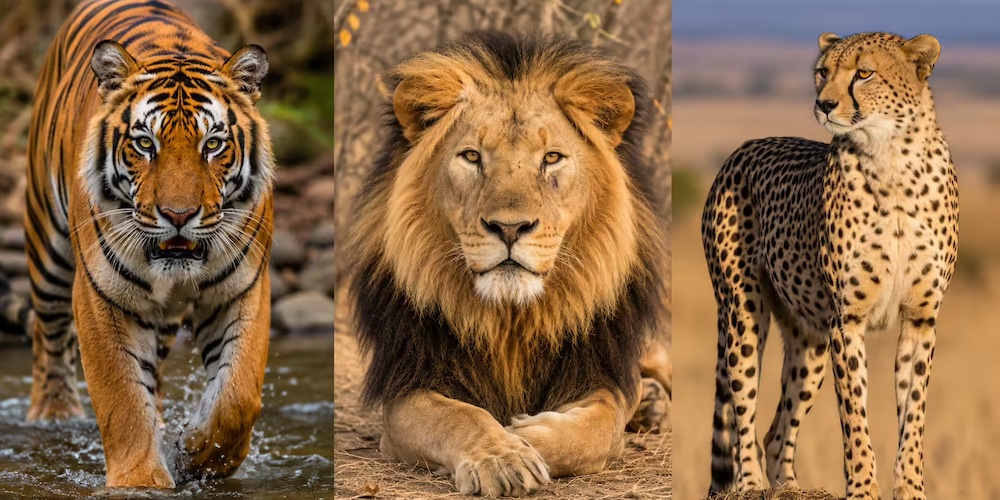
The initiative’s main objective is the conservation of seven major big cat species: the Tiger, Lion, Leopard, Snow Leopard, Cheetah, Jaguar, and Puma.
IBCA currently has 24 member countries, 5 observer countries (Kazakhstan, Namibia, Thailand, Ecuador, and Vietnam), and several range countries that encompass the natural habitats of big cats in the wild. All the United Nations member countries are eligible to become members of IBCA.
India has committed Rs.150 crore (2023-2028) in support to the IBCA and is exploring additional funding through bilateral, multilateral, and donor organisations.
Incidentally, on May 14, Union Minister for Environment, Forest and Climate Change, Bhupender Yadav, inaugurated the ‘Lion’ Species Spotlight Event at Sasan Gir, Gujarat. The programme was organised as part of the series of Pre-Summit Species Events under the IBCA IBCA Summit 2026.

The event was presided over by Chief Minister (Gujarat), Shri Bhupendra Patel, through a virtual medium. Other dignitaries gracing the occasion included Gujarat State Forest Minister, Shri Arjun Modhwadia, Minister of State for Forest (Gujarat), Shri Pravin Mali, besides senior officials from IBCA, Union and State Governments.
Addressing the gathering, Bhupender Yadav informed that India will host the first-ever IBCA Summit 2026 in New Delhi on June 1–2, 2026, under the chairmanship of Prime Minister Shri Narendra Modi, followed by technical sessions on June 1–2. He said the summit with tagline — Save Big Cats, Save Humanity, Save Ecosystem — would bring together Heads of State and Government, Ministers, policymakers, scientists, conservation practitioners, multilateral agencies, financial institutions, partner organisations and 400 representatives from 95 range countries across Asia, Africa and the Americas. IBCA serves as a global coalition dedicated to the conservation of seven iconic Big Cat species — Tiger, Lion, Leopard, Snow Leopard, Cheetah, Jaguar and Puma — through collaborative international action and strengthened scientific and technical cooperation, he added.
The Minister described Sasan Gir as a living symbol of India’s rich biodiversity, sensitivity towards nature and commitment to conservation. He stated that the Gir lion is not only the identity of Gujarat, but also a symbol of the pride, courage and natural heritage of the entire nation. The Minister informed how, under the visionary leadership of Prime Minister Shri Narendra Modi, various steps like Asiatic Lion Population Estimation initiative, National Wildlife Referral Centre in Junagadh and developing Barda National Wildlife Sanctuary as the site for natural dispersal of Asiatic Lion, are being taken ahead in mission mode.
Shri Yadav said the ‘Lion’ Species Spotlight Event highlighted the global conservation status of lions and India’s initiatives towards species conservation. He stated that the event aimed to showcase India’s successful lion conservation model, promote international cooperation among lion range countries, deliberate on emerging challenges such as habitat pressures, climate change and human-wildlife interactions, and strengthen knowledge exchange and capacity building.
Describing lions as one of the world’s most iconic and social Big Cat species, Shri Yadav said lions are apex predators that play a vital ecological role by regulating herbivore populations, maintaining ecosystem balance and shaping biodiversity and inter-species dynamics. He noted that lion populations globally have declined by more than 30 per cent due to habitat loss and degradation, while the Asiatic lion survives as a single wild population in India’s Gir landscape.
Highlighting India’s conservation success, Shri Yadav informed that the lion population in the Greater Gir Landscape has risen to an estimated 891 individuals in 2025, marking a 32 per cent increase compared to 2020. He said effective conservation and management efforts have helped stabilise and expand lion sub-populations across several regions of the Gir landscape. The Minister noted that the Asiatic lion receives the highest level of legal protection under Appendix-I of CITES and Schedule-I of the Wildlife (Protection) Act, 1972. He further highlighted that ‘Project Lion’, launched by the Government of India in 2020, adopts a comprehensive landscape-based approach for the long-term conservation of Asiatic lions through habitat restoration, population management and ecological resilience.
Concluding his address, Shri Yadav said the IBCA Summit 2026 will further strengthen international cooperation, public awareness, knowledge sharing and adoption of best conservation practices to secure a stronger socio-ecological future for Big Cats and their habitats.