India’s Multi-Billion-Dollar Medical Value Travel Industry

India’s healthcare system is rapidly emerging as a preferred global medical tourism destination, with the market expected to exceed USD 13 billion by 2026, growing from approximately USD 6 billion in 2022. As of 2024, nearly 650,000 international patients annually chose India for medical treatment. The sector’s growth is driven by a unique combination of high-end clinical expertise, advanced technology, and significant cost advantages compared to Western nations.
To understand India as a global healing centre, it is essential to distinguish between its two vibrant pillars:
• Medical Tourism: It focuses on curative interventions such as complex surgeries, organ transplants, and advanced diagnostic care provided by specialised hospitals and healthcare institutions.
• Wellness Tourism: It centres on preventive and holistic well-being through traditional systems such as Yoga, Ayurveda, Naturopathy and other AYUSH practices. It offers therapies that promote physical, mental and spiritual health.
Together, these two pillars form the foundation of India’s Medical Value Travel ecosystem. They address both advanced clinical treatment needs and the rising global demand for preventive healthcare.
According to the Medical Tourism Index 2020–21:
• India ranks 10th among the top 46 medical tourism destinations globally
• 12th among the world’s top 20 wellness tourism markets
• 5th among the top 10 wellness destinations in the Asia-Pacific region.
As per Ministry of Tourism estimates, in FY24, travel and tourism contributed 5.22 per cent to GDP, close to pre-pandemic levels. The sector also supported an estimated 8.46 crore direct and indirect jobs, accounting for about 13.3 per cent of total employment.
The latest data for 2025 highlights the sector’s momentum:
• Foreign Tourist Arrivals (FTAs): In 2025, India recorded 9.15 million FTAs.
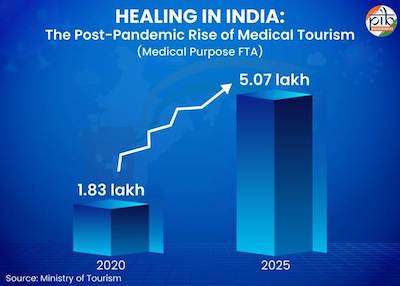
• Medical Purpose Arrivals: In 2025, 507,244 foreign nationals arrived specifically for medical treatment.
• Sectoral Share: 2025 data shows that medical tourism constitutes approximately 5.5% of total FTAs.
• Leading Markets: According to 2025 figures, the top source countries for medical tourists include- Bangladesh (3,25,127 arrivals), followed by Iraq (30,989), Uzbekistan (13,699), Somalia (11,506), Turkmenistan (10,231), Oman (9738), and Kenya (9,357).
• Patients from other countries primarily travel to India for specialised treatments such as:
– Cardiac surgery
– Orthopaedic procedures
– Cancer treatment
– Organ transplants
– Neurological interventions
– Cosmetic surgery
– Dental care
– Fertility treatment
– AYUSH-based wellness therapies
Advanced Technology and Accreditation
India’s healthcare system is supported by robust quality assurance mechanisms and internationally recognised accreditation standards. Hospitals and healthcare providers across the country obtain accreditation from the National Accreditation Board for Hospitals and Healthcare Providers (NABH).
NABH establishes rigorous benchmarks for patient safety and quality of care. As of 2026, NABH has accredited over 1,299 hospitals using more than 600 safety parameters. Meanwhile, the Quality Council of India oversees systematic quality improvement.
NABH accreditation is recognised globally through its affiliation with the International Society for Quality in Healthcare (ISQua). In addition, several Indian hospitals hold Joint Commission International (JCI) accreditation. It places the hospitals among healthcare institutions that meet globally accepted standards of clinical excellence.
Medical Value Travel (MVT) service providers are primarily concentrated in the Delhi Capital region, and cities in Southern and Western States of India like Hyderabad, Chennai, Bengaluru, Cochin, Mumbai and Pune.

Key Factors Attracting Global Patients
• Cost-Effective Healthcare: Medical procedures in India can cost 60–90% less than in the US or UK, allowing access to high-quality care at a fraction of the cost.
• Minimal Wait Times: Unlike systems in the West, India offers little to no wait times for complex surgeries, such as organ transplants, cardiac bypass, or orthopaedic procedures.
• High-Quality, Expert Care: India has one of the world’s largest pools of trained medical professionals, with many doctors having trained in developed nations. Numerous hospitals are accredited by NABH and JCI (Joint Commission International), meeting global safety standards.
• Integrated Wellness: Beyond conventional medicine, India integrates traditional systems like AYUSH (Ayurveda, Yoga, Unani, Naturopathy) to offer holistic recovery.
• Easy Medical Visa Process: The Government of India provides e-Medical Visas and attendant visas for 166 countries, which can be processed in 24-48 hours
Strengthening AYUSH-led Medical Value Travel
India possesses a unique advantage in wellness tourism through its centuries-old traditional systems of medicine collectively known as AYUSH — Ayurveda, Yoga, Naturopathy, Unani, Siddha and Homoeopathy.
As the birthplace of Yoga and Ayurveda, India continues to promote these systems as integral components of holistic health and preventive care.
• AYUSH Visa Facilitation: To streamline access for international patients, the Government of India introduced a dedicated AYUSH Visa on 27 July 2023. It enables foreign nationals and their attendants to travel to India specifically for treatment under recognised AYUSH systems.
• Quality Standards: Efforts are underway to strengthen credibility and standardisation in the sector. The Bureau of Indian Standards (BIS) has adopted ISO 22525, an international standard related to medical wellness tourism services.
• Insurance Coverage: Insurance coverage for AYUSH therapies has also expanded significantly. Under the Health Insurance Regulations of the Insurance Regulatory and Development Authority of India (IRDAI), insurers are permitted to cover treatments under AYUSH. As a result, around 27 insurance companies now offer more than 140 policy products covering AYUSH treatments.
• Global Engagement and Ecosystem Development: Medical Value Travel remains a key theme across major AYUSH initiatives. This includes the “Global Synergy in AYUSH: Transforming Health and Wellness through Medical Value Travel” Summit, held in Mumbai (2024) and Chennai (May 2025).
• Capacity building is being strengthened through initiatives such as the AYUSH sub-council under the Health Sector Skill Council.
Key Patient Source Markets
While traditionally attracting patients from South Asia, Africa, and the Middle East, India is increasingly receiving patients from developed economies, including the UK, the USA, Australia, and Canada.
Global outreach is also expanding through platforms like the WHO Global Traditional Medicine Summit, the Know India Programme, and AYUSH initiatives showcased during Maha Kumbh Mela 2025.
In sum, India’s medical and wellness tourism ecosystem is evolving into a globally trusted model of integrated healthcare. It combines modern medical infrastructure with traditional systems such as AYUSH. This enables both curative and preventive care. Strong government policy, digital facilitation, and international quality standards support this growth. Expanding global outreach is further strengthening India’s position as a comprehensive destination for Medical Value Travel.
As global demand rises, India is poised to play a key role in shaping the future of global healthcare and wellness travel.