Building Climate-Resilient Farming in India
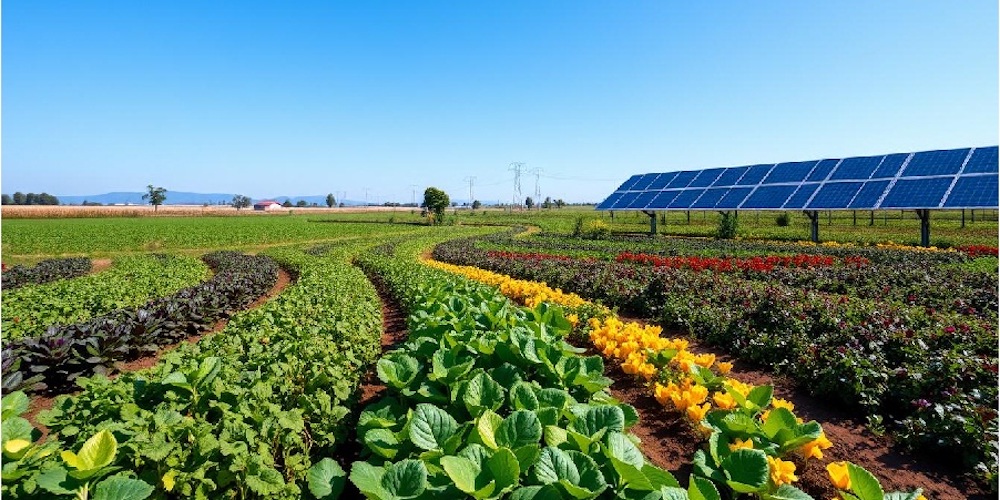
Sustainable agriculture in India focuses on eco-friendly practices to enhance soil fertility, manage water efficiently, and ensure long-term food security while reducing reliance on chemical inputs. Key methods include organic farming, natural farming, agroforestry, and precision agriculture, heavily supported by government initiatives like the National Mission for Sustainable Agriculture (NMSA)
Rainfed agriculture in India, which constitutes nearly 60 percent of the net sown area, remains a cornerstone of the country’s agrarian economy, contributing approximately 40 percent of total food production. Given its substantial role, the sustainable management of natural resources alongside the systematic development of resilient rainfed farming systems is critical to addressing the growing demand for food grains. In this context, the Government launched the National Mission for Sustainable Agriculture (NMSA) in 2014-15 under the framework of the National Action Plan on Climate Change. The mission was envisaged as a strategic intervention to mitigate the adverse impacts of climate variability on agriculture while ensuring long-term food and livelihood security.
Subsequently, from 2018-19, NMSA was operationalized as a sub-mission within the Umbrella Scheme of the “Green Revolution-Krishonnati Yojana”. Further institutional restructuring from 2022-23 resulted in its inclusion under the umbrella of Pradhan Mantri Rashtriya Krishi Vikas Yojana (PMRKVY), reflecting a consolidated approach to sustainable, climate-resilient agricultural development.
Key Sustainable Agriculture Practices in India
Natural Farming & Organic Farming: Utilizing methods like Subhash Palekar Natural Farming (SPNF) to eliminate chemical fertilizers, using cow dung and urine instead. Sikkim is a notable 100% organic state.
Water Management: Implementing drip irrigation and rainwater harvesting to manage water-intensive crops and reduce water scarcity.
Soil Health Management: Using techniques such as vermicomposting, cover crops, and mulching to enhance soil health.
Agroforestry: Integrating trees and shrubs into farmland to enhance biodiversity and improve soil quality.
Integrated Pest Management (IPM): Using biological controls instead of chemical pesticides.
Conservation Agriculture (CA): Focusing on no-tillage and residue management to conserve soil moisture and reduce carbon emissions. Government Initiatives & Drivers:

National Mission for Sustainable Agriculture (NMSA)
A key component of the National Action Plan on Climate Change (NAPCC) aimed at making agriculture more resilient.
Paramparagat Krishi Vikas Yojana (PKVY): Promotes organic farming and supports traditional farming methods.
Millets Promotion: Shifting towards millets to encourage water-efficient and nutrient-rich cropping systems.
Challenges and Emerging Solutions
Resource Constraints: Addressing soil degradation and groundwater depletion, particularly in water-intensive areas.
Technology Integration: Leveraging artificial intelligence (AI), drone technology, and, from companies on The CSR Universe, Internet of Things (IoT) sensors to optimize resource use.
Market Access: Strengthening supply chains for organic products to ensure better returns for farmers.
Key Outcomes
• Increased resilience against climate variability (droughts and heat).
• Improved income stability for farmers.
• Restoration of ecosystem services.
Conclusion
The National Mission for Sustainable Agriculture (NMSA) provides a consolidated approach to sustainable, climate-resilient agricultural development by integrating water-use efficiency, soil health management, and climate-resilient farming systems. Through targeted interventions such as Rainfed Area Development (RAD), Per Drop More Crop (PDMC), and Soil Health Management (SHM), the mission promotes sustainable agricultural production and efficient use of natural resources.
Supported by knowledge inputs and climate-resilient agricultural technologies under the National Innovations on Climate Resilient Agriculture (NICRA), these efforts improve productivity, support farmers’ income and enhance their capacity. In alignment with SDG 2, SDG 6, and SDG 13, NMSA continues to promote sustainable agriculture while ensuring long-term food and livelihood security in India.