RETURN OF THE SACRED
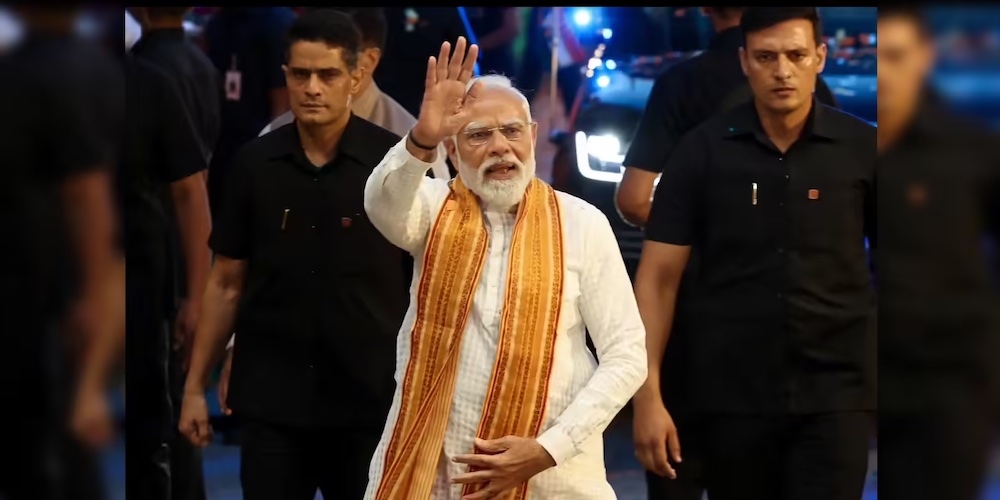
Do you remember the taali, the thaali, and the crowd moment? In 2020, a political expert observed that when Narendra Modi asked Indians to bang utensils and turn off their lights during the coronavirus lockdown, he was creating new rituals of populism and renewing the bond between leader and people through shared spectacle. But this view missed something the ‘liberal’ perspective often cannot see: the participants were not just being mobilised. They were waking up. This awakening, built over decades, has now reached a point of no return.
The BJP’s victory in West Bengal in May 2026 (206 seats versus 80 for the Trinamool Congress) is not a routine swing in Indian electoral democracy. It marks the final collapse of a cultural dam that had been cracking since 1990. Videos from Bengal after the results showed people weeping at BJP offices, elderly women pressing sindoor-marked hands to photographs of Ram, young men in Purulia and Jalpaiguri chanting Jai Shri Ram with tears streaming down their faces, and torchlight processions that resembled festivals of liberation more than political celebrations. These were not engineered or coordinated by a communications cell. They were spontaneous expressions of a civilizational emotion, without a name in the English political lexicon, but one every Hindu understands at heart.
To understand why this is occurring now and its implications for India’s future, we must look much further back than 2014 and even beyond 1992. We must return to the foundational issue: the seventy-year effort to construct a modern Indian nation-state by suppressing, ridiculing, and systematically delegitimising the lived spiritual culture of the majority population.
(I) The Great Suppression – How Nehruvian India Made Hinduism Shameful
The Nehruvian project was, at its core, a civilizational replacement operation. Nehru and the westernised elite of the Congress ‘High Command’ understood that India’s ancient civilisation (its ritual life, temple culture, sacred geography, guru-shishya traditions, vision of time as cyclic rather than linear, and interpretation of the cosmos as conscious and moral) was incompatible with the modern, secular, bureaucratically administered nation-state they wished to build. So, in a process never acknowledged, they set about making that grammar invisible.
The tools were elegant in their indirectness. Schools taught Nehru’s ‘Discovery of India’ as the authoritative account of who Indians were. History syllabi treated temple-building dynasties (the Cholas, Pallavas, Vijayanagara Empire, Ahom kings) as pre-modern curiosities, while the Mughal period was presented as a cosmopolitan golden age. The Vedas and Upanishads, texts of astounding philosophical sophistication that influenced Schopenhauer, Emerson, and Heisenberg, were classified as ‘religion’ and thus private, irrational, and unsuitable for public life. State-funded cultural institutions were almost exclusively patronised by people who embraced the secular-modernist worldview.
The impact on popular culture was substantial. In Hindi cinema of the 1950s and 60s, when urban Indians were forming their first mass-shared culture, the village priest was a figure of comedy or exploitation. The sadhu was either a villain or a buffoon. The genuinely religious woman was either passive or victimised. The hero was invariably the secular rationalist – sometimes a scientist, sometimes a socialist, but always a man who had overcome the ‘superstitions’ of his parents’ world. Raj Kapoor’s films defined this era – beautiful, humanist, and relentlessly anti-traditional. As late as 1983, Amitabh Bachchan appeared on the poster for Coolie holding a hammer and sickle. The devout Hindu was largely a figure of nostalgia. Never a protagonist. Never aspirational. Never cool.
And yet, even in the act of suppression, the Nehruvian state produced something it did not intend, i.e. a reservoir of resentment. Not a crude or bigoted resentment, but an intense, civilizational wound. The wound of having been told, by your own government, in your own schools, in the language your children were being trained to think in, that who you are is not quite good enough. That your mother’s rituals are superstition. That your father’s deity is a myth. That your grandmother’s knowledge of the stars is astrology, not science. The temple at the centre of your village is a historical artefact, not a living sacred space. This wound was inflicted not by conquerors but by those who ruled. And that, paradoxically, made it deeper.
(II) The Pracharak Who Would Come To Be The Priest King – The Making of Narendra Modi
To understand the man who would eventually become the vehicle for this civilizational reclamation, one must abandon the conventional political biography and read him instead as a product of a very specific and very old Indian institutional tradition, i.e. the tradition of the ascetic-organiser.
Narendra Damodardas Modi was born in 1950 in Vadnagar, a small town in northern Gujarat, into a family of oil-pressers (the Ghanchi community) classified under the Other Backward Classes. His father sold tea at the railway station, and young Narendra helped him. Nothing in the material circumstances of his childhood should have produced a Prime Minister. And yet it did. Because at the age of eight, Narendra Modi walked into the local shakha of the Rashtriya Swayamsevak Sangh.
The RSS shakha is a peculiar institution. It is described by its critics as a paramilitary organisation, by its friends as a cultural brotherhood, and by neither description adequately. What it actually is is a daily practice of physical, intellectual, and moral formation – part gymnasium, part debating society, part philosophy class, part sangha. Boys gather every morning before school. They do exercises, play games, and hear stories about great figures of Indian civilisation such as Chandragupta Maurya, Adi Shankaracharya, Maharana Pratap, and Swami Vivekananda. They learn to think of themselves as part of something great, larger than their caste, their village, their family. They are taught that India is not simply a geographic territory but a living civilizational project to be revered as ‘Bharat Mata’, and that each of them is responsible for her welfare.
Narendra Modi’s induction into the RSS was deeply spiritual. Before becoming a full-time pracharak, he spent two years wandering India – visiting the Ramakrishna Mission in Belur Math, the ashram at Almora, then traversing the Himalayan foothills. By his own account, he sought to renounce the world entirely. He went to Belur Math to become a monk but was turned away. He went to the Ramakrishna Ashram in Almora and was turned away again. These facts are inconvenient to the Indian liberal ecosystem and often ignored. The man who would conduct the Prana Pratishtha of the Ram Mandir tried in his youth to become a sannyasi. He was refused that path. Dharma had other plans.
The influence of Swami Vivekananda on Narendra Modi’s life cannot be overemphasised. Vivekananda’s central insight that Vedanta is not a quietist philosophy of withdrawal but a muscular, world-transforming doctrine of service perhaps became the intellectual spine of Modi’s understanding of public life. The famous formulation that ‘service to man is service to God,’ that the poor man is Narayana, and to lift him is to worship Narayana, is a Vivekananda doctrine. It resolved, for Modi, the apparent contradiction between spiritual aspiration and political action. He could be both a devotee and an organiser. The pracharak’s life of celibacy, no personal property, eighteen-hour days, no fixed home, and absorption into the mission were, in their own way, a form of sannyasa.
When Narendra Modi became a full-time pracharak in 1972, his day began at 4:30 AM and ended past midnight. He lived in the Hedgewar Bhawan in Ahmedabad’s Maninagar, shared a room with other pracharaks, owned nothing, and devoted his extraordinary energy entirely to building the Sangh network. His mentor, the prant pracharak Lakshmanrao Inamdar (known as Vakil Sahab), called him his manas putra (his mind-born son), a term from the Dharmashastra tradition signifying a disciple formed not through blood but through intellectual and spiritual transmission.
It was Narendra Modi who organised the Gujarati segment of Advani’s 1990 Rath Yatra, an important moment in the modern history of Hindu political consciousness. The yatra began at Somnath, the temple repeatedly destroyed and rebuilt over the centuries, and terminated in Ayodhya. When Modi became the national organiser of the 1991 Ekta Yatra from Kanyakumari to Srinagar, he already blended the RSS pracharak’s organisational discipline with a politician’s instinct for crowds and symbolism. By the time he became Gujarat’s Chief Minister in 2001, he had spent three decades in the making. No contemporary Indian politician of any party has served so long a moral and organisational apprenticeship before assuming executive power.
(III) The 1990s and the Cracking of the Dam
Liberalisation gave the mercantile castes – the Banias, the Marwaris, the Khatris, the Chettiars – a new economic legitimacy that their social world had long granted them, but the Nehruvian state had systematically denied. Making money became, for the first time in independent India, something a respectable person could openly aspire to. The television serials of the early 1990s (the K-serials on Star Plus, Zee TV’s family dramas) were not mere middle-class entertainment. They were, in sociological terms, a counter-hegemonic project. They made the rituals of the Hindu household, i.e. Karva Chauth, Navratri, puja, the breaking of fast, the thali, the mangalsutra, all the central drama of the shared popular imagination for the first time since the Doordarshan era.
But what secular analysis misses is the deeper civilizational logic at work. The economic opening also meant the information opening. Indians with satellite television could, for the first time, see themselves reflected in a global mirror, and what they saw disturbed them. The promise of the Nehruvian project that secular modernism would produce an India competitive with advanced nations within a generation had manifestly failed. If Nehruvianism had failed materially, perhaps it had also been wrong in its cultural prescriptions. Perhaps seventy years of being taught to be ashamed of your tradition had not made you progressive. It had merely made you rootless.
The rediscovery of Hindu identity in the 1990s was, therefore, a civilizational immune response. People who had been told their traditions were primitive began asking: ‘By whose standard?’ People who had been told their history was one of victimhood and backwardness began asking: ‘Then how do you explain the temples of Hampi, the mathematics of Aryabhatta, the grammar of Panini, the surgery of Sushruta?’ People who had been told their cosmology was superstition began asking: ‘Then what do you make of the fact that concepts like the cyclical universe, the holographic nature of consciousness, etc., dismissed as Hindu mythology for a century, are now the frontier of modern physics?’

(IV) The Screen as Sacred Space – How Popular Culture Became the New Battlefield
What happened in Indian cinema after 2015 is a radical story, and it happened not in Mumbai but in the South. Baahubali (2015) was the first signal. S.S. Rajamouli’s magnum opus, a story of a warrior king, dharmic lineage, betrayal, and restoration, was dismissed by English-language critics as bombast, as spectacle without substance. What they failed to see was that it was doing something that Hindi cinema had been afraid to do for 60 years: presenting the Hindu civilizational imagination on its own terms, without apology, without the condescension of the secular gaze, without irony. Its worldwide gross exceeded Rs. 1,800 crore. ‘Why did Kattappa kill Baahubali?’ became the first truly pan-Indian popular-culture moment of the new-media age.
But the civilizational cultural statement of this decade was Kantara (2022). Rishab Shetty’s film, on the surface, is a conflict between a tribal community and a forest official. At its core, it is about the relationship between a people and their deity. A deity who is not metaphorical, symbolic, or a projection of collective psychology, but real, present, and capable of direct intervention in human affairs. The climax, where the protagonist becomes possessed by the village deity and achieves transcendent martial fury, was described by audiences across India not as ‘powerful cinema’ but as a ‘spiritual experience.’ People reported weeping without knowing why. They described the film not with aesthetic vocabulary but with that of darshan. The film grossed over Rs. 400 crore worldwide, but its cultural contribution was immeasurable.
What these films have in common (Baahubali, KGF, Kantara, RRR) is that they broke a rule Bollywood enforced for six decades. The rule was that the Hindu must never be the straightforward hero in his own story, that his traditions must always be examined with critical distance, and that the claim of the sacred must always be qualified by the rationalist’s parenthesis. South Indian cinema refused this rule. It made films where the deity is real, the dharma is true, the warrior’s devotion is noble, and the people’s civilizational heritage is worth defending with your life.
The spectacular failure of a major A-lister’s remake of a Tom Hanks classic and a Rs. 180 crore budget, alongside the blockbuster success of Karthikeya 2, a small Telugu film about a quest for Krishna’s secret, was the moment the market registered what the algorithm had already known: the Hindu audience had found its own voice and was no longer prepared to rent it to the secular establishment.
If Kantara proved that the sacred could shake a live-action audience into something resembling darshan, Mahavatar Narsimha (2025) proved it could do the same through animation — and in doing so, broke every assumption about what Indian popular culture is capable of. It became the highest-grossing Indian animated film of all time, surpassing even The Lion King’s collection in India. It was the seventh-highest-grossing Indian film of 2025. And when audiences emerged from theatres describing the final sequence — in which Narasimha manifests from a stone pillar to the sound of the Ugram Viram Maha Vishnum stotra — as a “divine experience” rather than a cinematic one, they were not deploying hyperbole. They were reporting something real. That a mass Indian audience in 2025 sat for over two hours with a film that refused to modernise or ironise this material — that it went in expecting animation for children and emerged shaken — tells you something that the box office number cannot: that the hunger for mythology presented at full philosophical depth, without the secular parenthesis, is no longer niche. It is the market.
Dhurandhar (2025) and its sequel (2026) are to the Hindu nationalist imagination what Narasimha is to Hindu mythology: a sustained, popular effort to portray the Indian state – its agencies, covert operatives, and willingness to act abroad – as aspirational. In a culture that spent seventy years being taught that power is inherently corrupt and that the state is an instrument of oppression, the genre Aditya Dhar has built is a civilizational argument. That Indian sovereignty is worth defending, that the men who defend it are worthy of epic treatment, and that the audience watching them is part of a national story that has protagonists.
(V) The Algorithm as Guru – Digital India and the New Hindu Consciousness
India has approximately 85 crore internet users. It is the world’s largest market for short-form video content. YouTube India has become, over the decade from 2014 to 2024, the single most important site of popular intellectual formation in the country. And what has happened on Indian YouTube between 2015 and 2026 is a civilizational revolution disguised as entertainment.
The emergence of a vast ecosystem of Hindu content, i.e., Gita lectures, Purana storytelling, channels explaining mythology, astrology education, Ayurvedic science, temple history, and Sanskrit learning, has created something entirely new in Indian public life – a middle class that is simultaneously digitally sophisticated and traditionally rooted. Young people who are fluent in React.js, can trade crypto, and wear AirPods are also watching three-hour explanations of the Bhagavata Purana, learning to read their birth charts, doing Navratri fasts with the same seriousness with which they track their macros, and getting Sanskrit shlokas tattooed on their forearms.
Sadhguru Jaggi Vasudev commands a social media following that dwarfs most global media brands – over 10 million followers on Instagram, 7 million on Twitter, and a YouTube channel with billions of views. His genius lies in translating Advaitic and Shakti philosophy into the vocabulary of the self-help era, i.e. mental performance, well-being, inner engineering, and ecological consciousness. He speaks to the Indian urban professional in the language of optimisation while, below the surface, delivering the framework of Sanatana Dharma. He presented at Davos and addressed the United Nations. He represents the Hindu civilizational claim, made aspirational for the globally connected Indian professional.
Generation Z is where this crystallises most sharply and most surprisingly. Born between 1997 and 2012, India’s Gen Z is the first generation to have grown up entirely in the post-liberalisation, post-internet, post-secular dispensation. They have no memory of the Nehruvian consensus as a lived reality. They know it only as an idea that failed. They have watched, online, a global resurgence of civilizational pride across every culture on earth, i.e., the Koreans with K-pop and K-drama, the Japanese with anime and manga, and they have asked, with the bluntness characteristic of their generation, ‘Why not us?’ Data points across surveys are consistent, young Indians between 18 and 30 are more religiously observant than their parents, more comfortable with overt Hindu identity markers, and more politically aligned with the Hindu nationalist project than any generation since independence.
(VI) The Consecration – January 22, 2024
On the 22nd of January 2024, Narendra Modi descended into the sanctum sanctorum of the Ram Mandir at Ayodhya and, dressed in traditional attire in the colour of the sun, performed the Prana Pratishtha of Ram Lalla (the consecration of the idol, the invocation of the divine presence, the act by which a statue of stone becomes an inhabited deity). He had observed eleven days of ritual preparation beforehand – a vrat that included sleeping on the floor, bathing in holy rivers, consuming only sattvic food, performing daily puja, and immersing himself in scriptural recitation. He emerged not as a Prime Minister conducting a state ceremony but as a ‘yajamana’ or a ritual patron performing a sacred obligation on behalf of the entire community.
The distinction matters enormously. The Prana Pratishtha is not a symbolic ceremony. It is believed to be a point where the human and divine worlds intersect. When Narendra Modi performed this ceremony, he was not inaugurating a government project. He was fulfilling the civilizational obligation of the ruler in the Dharmashastra tradition, i.e., the king’s duty to protect and restore the sacred geography of the kingdom. The fact that no Prime Minister of India had performed such an act in 77 years of independence meant that this moment carried the weight of a deferred obligation that wasn’t merely political but cosmic in the traditional Hindu understanding.
5 lakh people came to Ayodhya on the first day the temple was open. Over the subsequent month, daily footfall settled between 1,00,000 and 1,50,000. The donations to the temple trust reached approximately Rs. 5,000 crore – raised from 12.7 crore individual donors, making it among the largest crowd-funded construction projects in human history. The ninety-year-old woman from Chhattisgarh who had travelled over 700 kilometres, clapping and chanting, and who credited Modi entirely for the moment she could stand before her Lord’s garbhagriha. She was not a manufactured political spectacle. She was the living embodiment of a civilizational longing that no sociological framework invented in Cambridge or Columbia can adequately describe.

(VII) The Priest-King – Narendra Modi in the Dharmashastra Tradition
Across Indian political philosophy, from the Arthashastra to the Dharmashastra texts, from the Kamandakiya Nitisara to the Rajatarangini, there exists a concept that has no equivalent in Western political thought – the Rajrishi. Literally, the king who is also a rishi, i.e. the ruler who has absorbed, through spiritual discipline, the capacity for disinterested action that the Bhagavad Gita describes as nishkama karma. The Rajrishi is not a theocrat. He is not a philosopher-king in Plato’s sense. He is something more difficult to categorise. A man who has undergone the inner transformation that produces genuine dharmic clarity, and who therefore acts, even in the most worldly domain of politics, from a place of transcendent orientation.
Narendra Modi is the first figure in post-independence Indian politics who can be seriously analysed within this scheme. He is a celibate. He practices yoga and meditation daily, not as performance but as personal discipline traceable to his pracharak years. He retains the personal austerity of his ashram formation – the 4 AM wakeup, the vegetarian diet, the extraordinary physical and mental stamina. He has no personal wealth, no family benefiting from his position, and no discernible personal ambitions beyond the mission he has consistently described since his youth – the restoration of India to civilizational greatness.
When he took office in 2014, his first act as Prime Minister-designate was to bow before the Central Hall of Parliament, touching his forehead to the steps. When he inaugurated the new Parliament building in May 2023, he performed havan and installed the Sengol – the sacred sceptre of the Chola dynasty, which had been presented to Nehru at independence as a symbol of the transfer of sovereignty but had been subsequently stored in a museum and mislabelled as a ‘golden walking stick.’ The Sengol’s restoration to the Parliament building was a statement about the nature of legitimate authority. That Indian sovereignty is not simply procedural and constitutional but rooted in a metaphysical moral order.
The establishment of the International Day of Yoga at the United Nations, with Modi himself performing yogasanas on the lawns of the UN headquarters in New York and 177 nations participating, was perhaps the most consequential soft-power act of any Indian Prime Minister since Nehru. But where Nehru projected India’s influence through the grammar of secular non-alignment, Modi projected it through the grammar of Sanatana civilizational heritage. The world did not receive this as Hindu nationalism. It received it as wisdom. That distinction, between a parochial assertion of religious identity and a universal civilizational offering, is the distinction Modi has mastered more completely than any Indian political figure of the modern era.
(VIII) The Bengal Question – Civilisation, Not Just Politics
West Bengal is not simply another state in the BJP’s electoral arithmetic. It is the site of the most consequential civilizational battle in the history of the Hindu right. One that carries the deepest emotional resonance for reasons that have nothing to do with seat counts or vote shares.
Bengal was the birthplace of the Bengal Renaissance – the 19th-century movement that produced Ramakrishna Paramahamsa, Swami Vivekananda, Bankimchandra Chattopadhyay, and Rabindranath Tagore. It was from Bengal that the modern articulation of Hindu philosophical and civilizational pride first emerged in the post-colonial world. Vivekananda’s address at the Parliament of the World’s Religions in Chicago in 1893, when he stood up in front of a Western audience and said, with absolute confidence, ‘Sisters and brothers of America,’ was the first time in the modern era that a Hindu had spoken to the world not as a supplicant but as a representative of a living wisdom tradition of universal value. The RSS, whose institutional DNA carries the Vivekananda tradition as its deepest inheritance, is the organisation from which Narendra Modi emerged.
That Bengal, Vivekananda’s Bengal, Ramakrishna’s Bengal, the Bengal of Bankim’s Vande Mataram, had been governed for over four decades by a combination of Marxist ideology and subsequent Muslim appeasement politics, constituted a wound the Hindu nationalist tradition has borne with particular pain. The 2026 result with the BJP at 206 seats, the TMC reduced to 80, Mamata Banerjee’s edifice collapsed, and landed not as an election result but as a civilizational correction. The people weeping in BJP offices in Purulia and North Bengal were not weeping because their party won. They were weeping because their identity was, for the first time in living memory, validated by the democratic procedure in the land that gave India Vivekananda.
(IX) The Global Sanatana – When Dharma Became a Diaspora Identity
Something unprecedented has happened in the global Indian diaspora over the past decade. The pattern of previous generations, i.e., the anxious assimilation, the strategic invisibility, the hyphenated identity worn as a provisional compromise, has given way, among younger diaspora Indians, to a confident, assertive, globally rooted Hindu identity.
Young Hindu students at Ivy League universities are founding Hindu student organisations that run Navratri garba events attended by thousands, challenge university administrations on Hindu representation in religious life programming, and push back against Hinduphobic comments in academic syllabi with the same organised energy that other communities bring to their own advocacy. The Indian-American Gen Z is simultaneously the most professionally prominent ethnic group in its country and the most openly, unapologetically Hindu. They do not choose between their heritage and their modernity. They refuse the choice.
The global yoga industry (estimated at over $100 billion annually) is a Sanatana civilizational export of staggering proportions. Every morning, in cities from Stockholm to Sao Paulo, millions of non-Hindus perform asanas derived from the Hatha Yoga Pradipika and regulated by Patanjali’s Yoga Sutras, breathe according to pranayama techniques codified by unnamed rishis two thousand years ago, and close their sessions with ‘Namaste’ – the recognition that the divine in me sees the divine in you. This is Sanatana Dharma’s greatest contemporary achievement – the export, without coercion and without theological insistence, of its practical technologies of consciousness to the entire world.
(X) The Communicative Architecture of a Civilizational Movement
The Nehruvian state’s communicative architecture was centralised, hierarchical, and elite-controlled. Doordarshan, All India Radio, the state-funded publishing houses, all these were transmission belts carrying a unified message downward from the intellectual establishment to the consuming public. The digital revolution inverted this architecture entirely. The Hindu communicative ecosystem of 2026 is radically decentralised, horizontally structured, community-generated, and algorithmically amplified.
Consider the architecture in layers. At the base level is the WhatsApp family group. This is where grandmothers send morning shlokas, where uncles share videos of temple renovations, and where cousins circulate news of BJP victories annotated with religious imagery. This is a digital replication of what the neighbourhood used to provide, i.e. the daily reinforcement of shared cultural identity. The WhatsApp group is perhaps the digital equivalent of the shakha – a daily practice of cultural formation that creates community, shared reference, and a sense of civilizational belonging.
Above that is the YouTube layer, where a twenty-two-year-old content creator from Jaipur with a smartphone and a gift for storytelling can produce a series on the historical evidence for the Ram Janmabhoomi claim, or a deep dive into the symbolism of the Nav Durga, or an explanation of why quantum mechanics validates Advaita Vedanta, and accumulate three million subscribers without any institutional support. This creator is not a BJP propagandist. He is a young Hindu who finds his tradition intellectually exciting and wants to share that excitement. His audience consists of other young Hindus who, until YouTube, had no venue for this excitement.
The rise of ‘Hindu Twitter’ between 2018 and 2024 was one of the most significant developments in Indian public discourse, yet English-language commentary almost entirely failed to understand it. It interpreted this ecosystem, the accounts challenging Hinduphobia, the historical counter-arguments, the memes, the solidarity networks, as a troll army, as organised BJP IT cells, as manufactured rage. What it actually was, in the main, was a community of people who had found, for the first time, a space where their civilizational identity wasn’t merely tolerated but vigorously celebrated.
Narendra Modi understands this architecture instinctively, not because he was briefed on it by communications consultants, but because it maps perfectly onto something he has known since his RSS shakha days – the power of daily, habitual, communal practice in forming identity. His Mann Ki Baat monthly radio addresses, his Yoga Day practices, and his carefully documented pilgrimages to Kedarnath, Kashi, Somnath, and Kamakhya are not public relations exercises. They are acts of civilizational communication: the ruler demonstrating, through his own physical practice, the vitality and legitimacy of the tradition.
(XI) What This Is, and What It Is Not
The secular analytical system consistently makes one fundamental error when confronted with the Hindu civilizational awakening. It insists on interpreting it as a reaction formation, as fear of the Other, as resentment of minorities, as the mobilisation of anxiety rather than the expression of genuine cultural vitality. This interpretation is not simply uncharitable, but it is empirically inadequate. It cannot explain why the same phenomenon is occurring simultaneously in the diaspora, where there is no minority-majority demographic tension. It cannot explain why it is driven disproportionately by the young and the educated. It cannot explain why its primary cultural expressions – Kantara, Sadhguru, the Ayurveda renaissance, the Sanskrit revival, the global yoga movement – are genuinely attractive to non-Hindus rather than threatening.
What this movement is, at its deepest level, is a civilisation returning to itself after an interruption. That interruption lasted approximately 500 years, i.e., from the Mughal period through British colonialism to the Nehruvian secular dispensation. In each of its three phases, the essential act was the same: the attempt to make Hindus aliens to their own tradition, to make them experience their civilizational heritage through the eyes of someone who found it inferior, superstitious, or politically convenient to manage. The civilizational awakening underway is, fundamentally, the rejection of that alien gaze.
The Unfinished Temple
There is a point about the Ram Mandir that the political analysis always omits, because it is simultaneously the most important and the most unmediagenic – the temple is not complete. The consecration of January 2024 installed Ram Lalla in the ground-floor sanctum. The full three-storey temple structure will take several more years to finish. Narendra Modi himself announced that the remaining construction will proceed. The Prana Pratishtha was performed in an incomplete structure.
The divine presence established through Prana Pratishtha is permanent. The deity does not depart when construction workers arrive. The sacred order does not pause for the secular timeline. What was established at Ayodhya on the twenty-second of January 2024 is not a building. It is a cosmological fact.
In this sense, the Ram Mandir is a perfect metaphor for the civilizational moment India occupies. The foundations are established. The consecration has been performed. The sacred geography has been restored. But the full architecture of a Hindu civilisation that is simultaneously ancient and modern, simultaneously secure in its tradition and innovative in its expression, simultaneously rooted in Ayodhya and visible in Singapore and San Jose, is still under construction.
The man who performed the consecration is, in the traditional understanding, the yajamana – the one who accepts the ritual responsibility and its consequences on behalf of the community. He will not complete the building alone. No, Rajrishi can. The building of civilisation is always a collective work. But the yajamana’s role, to perform the foundational act, to establish the sacred order, to make it possible for the work to continue, is precisely the role that has been performed.
The thali-banging of 2020 was a participatory political ritual. What no one could have known, writing in that difficult spring, was that it was also something more, perhaps a rehearsal. A practice in collective action for a civilisation relearning how to act together. The crowds at Ayodhya in January 2024 were larger. The crowds in Bengal in May 2026 were even more so.
The dam was breached long ago. What is unfolding now is not a flood, but rather the river returning to its natural course.
(Vasudha Madhogaria is Vice President, Special Projects BlueKraft Digital Foundation)