RIGHT ANGLE – The Congress Hypocrisy
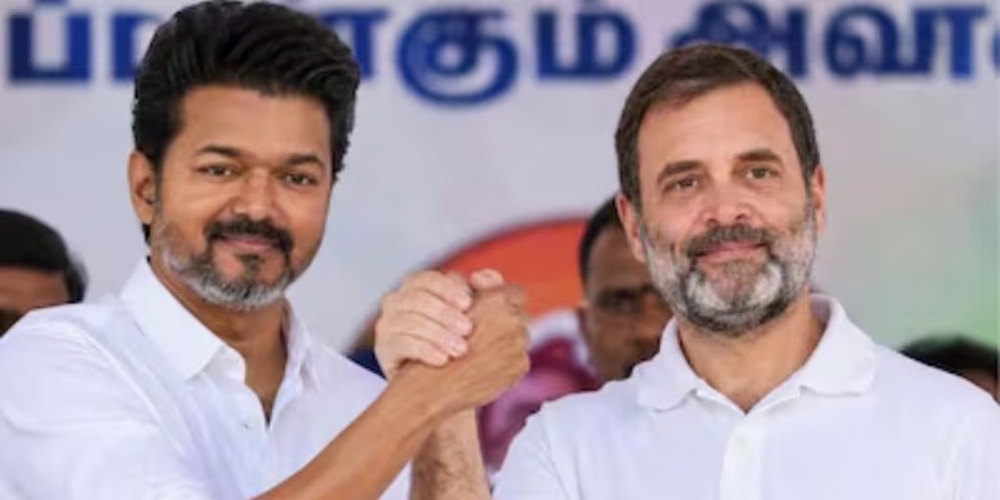
As I write this, I see on my TV screen Congress workers wildly celebrating in front of the party’s state headquarters in Chennai. They are bursting crackers and dancing, because they now hope to be a part of the new state government.
In fact, after seeing this, I decided to change the thrust of this column, which I had originally planned to focus on analysing the overall results of the Assembly elections in Assam, West Bengal, Tamil Nadu, and Kerala. But, now, I will concentrate more on the Congress party, its eternal young leader Rahul Gandhi, and its hypocrisy when it says that no other party in the country is fighting “to save the Indian constitution” as it is.
Tamil Nadu has produced a hung Assembly, in which the most unexpected winner is film star Vijay and his Tamilian Viduthalai Kazhagam (TVK).
The Congress fought the elections with the outgoing Chief Minister Stalin, with whose DMK it has been a partner both at the state and central levels for years. Stalin has been the most loyal ally of the Congress in general and Rahul Gandhi in particular in the so-called INDI Alliance against Prime Minister Narendra Modi. And it is because of the DMK, the party managed to win 5 (five seats); otherwise, on its own, it could not have won a single seat.
Incidentally, though the TVK won an impressive tally of 108 seats, it is still short of at least 10 more to secure the majority in what will be Tamil Nadu’s new Legislative Assembly and form the next government.
The opportunist Congress has exploited this weakness of the TVK. It has announced its support for actor-politician Vijay in forming the next government, by ending its longstanding alliance with the DMK. It is justifying the break by saying that it was the need of the hour for “a secular, progressive, and welfarist government, reflecting the aspirations of Tamil Nadu’s electorate”.
But then, the question arises whether the people of Tamil Nadu voted for the Congress to be in the government. The Tamil Nadu people actually voted as much against the DMK as against its allies like the Congress (The DMK reduced to 59 seats and its alliance to 73, including 5 of the Congress).
Obviously, the DMK is upset. It has accused Rahul Gandhi of being “a betrayer” and “a backstabber.”
But then the fact remains that this is not the first time that the Congress has humiliated the DMK in Tamil Nadu. During the Emergency in the mid-1970s, Indira Gandhi’s government in Delhi had dismissed the government led by Stalin’s father Karunanidhi, and arrested many DMK leaders.
The Congress was heavily involved in pressurising the then Prime Minister Chandrashekhar in 1991 to dismiss the DMK government, led by Karunanidhi, under Article 356, and that too without the statutory requirement of a report from the Governor regarding the law and order situation.
And again in November 1997, it was the Congress because of which the coalition government of Prime Minister I K Gujral came tumbling down after seven months in office in the wake of the report by the Jain Commission into the assassination of former Prime Minister Rajiv Gandhi that the DMK, a key coalition partner of Gujaral, of coddling a Sri Lankan guerrilla group LTTE, suspected of killing Rajiv Gandhi in a suicide bombing. The Congress, like the DMK, was a part of the then United Democratic Front.
Despite these instances, the DMK always forgave and allowed the parasite Congress to be its partner in the state government and during the Lok Sabha elections.
The parasitical nature of the Congress and its masters in the Gandhi family was further evident when, following the 2019 Maharashtra Assembly elections, the Shiv Sena broke its long-standing alliance with the Bharatiya Janata Party (BJP). Sena had contested the 2019 Maharashtra Assembly polls and bagged about 55 seats, made possible with campaigns heavily featuring Prime Minister Narendra Modi and a shared Hindutva agenda.
After the results, Sena leader Uddhav Thackeray claimed a 50:50 power-sharing formula — including the Chief Minister’s post — despite the BJP getting more than double the seats as Sena. Uddhav subsequently left the NDA and joined hands with ideological rivals, the Nationalist Congress Party (NCP) and the Congress, to form the Maha Vikas Aghadi (MVA) coalition government. For the Congress, the Sena, hitherto the most communal party in the country, became highly secular overnight!
As I have written on many occasions in the past, the Congress party has always thought that its masters, the Gandhis, have the divine right to rule India at Delhi, and the rulers of the states will be determined by them. In its absence, the Gandhis will say that as communal and fascist forces have captured power and all its institutions, they must be opposed tooth and nail.

See Rahul Gandhi now. The Congress has won in Kerala and is now eying a share in the Tamil Nadu government. Elections were fine for Gandhi in these two states. The EVM worked, and the Election Commission was fine.
But the same Election Commission is a villain for him in Assam and West Bengal because the BJP won there. Rahul says that the election was “stolen” in these two states. And he is shedding tears for the outgoing Chief Minister Mamata Banerjee, though they fought the elections separately.
And all this Rahul Gandhi justifies in the name of saving the Indian Constitution. After all, the Indian National Developmental Inclusive Alliance, or INDIA bloc, led by him, has made “Save the Constitution” its central slogan.
However, the fact remains that Gandhi’s actions, or for that matter that of the constituents in the INDIA block, reveals a pattern that weakens the very constitutional norms and offices they claim to protect. Let us see some examples in this regard.
In states where the INDIA alliance parties hold power, elected governments have repeatedly clashed with Governors and sought to reduce the office to a rubber stamp. Tamil Nadu, Kerala, and West Bengal have passed assembly resolutions and withheld bills from Raj Bhavan for months, then approached the Supreme Court to curtail the Governor’s discretion. The Constitution gives the Governor specific roles under Article 163 and Article 200. By portraying every gubernatorial action as politically motivated, the alliance degrades a constitutional office designed to act as a check between the Union and the states.
The Congress and its allies accuse central agencies like the CBI, ED, and Income Tax Department of bias whenever leaders face investigation. Several INDIA-ruled states have withdrawn general consent to the CBI, effectively blocking probes into state subjects. At the same time, the same parties use state police and vigilance units against opposition leaders. The principle that investigative bodies should function without political interference is applied selectively. This dual standard erodes public trust in institutions that the Constitution expects to remain impartial.
The Election Commission of India is a constitutional body under Article 324. During state and national polls, INDIA alliance leaders have questioned the ECI’s integrity and alleged EVM manipulation without evidence. When the results are favourable, the ECI is praised. When they are not, its independence is doubted.
The same has been their approach towards the judiciary. For them, the judiciary in general and the Supreme Court in particular must deliver judgments on the basis of what Rahul Gandhi or Mamata Banerjee says on a given issue. If the Court does its job and pronounces its verdict to the contrary, then that is because of a judicial takeover by the Modi government.
Under the leadership of Rahul Gandhi, the Congress has normalised mass suspensions, placard protests in the well, and refusal to participate in debates while demanding discussion. Walking out of both Houses, then claiming the government is stifling the opposition, has become routine. Parliament, under Article 79, is the forum where laws are made and the executive is held to account. By replacing debate with disruption, the Congress-led INDIA block reduces Parliament to a stage for slogans rather than a constitutional mechanism for accountability.
The alliance invokes federalism when central agencies act in opposition-ruled states, but remains silent when its own state governments dismiss elected mayors, supersede municipal bodies, or override elected panchayats.
In Punjab and Delhi, the AAP government, a key INDIA member, had repeated run-ins with the LG and Centre over administrative control. The Constitution creates a balance between Union and state powers, but the Congress and its allies use federalism only as a shield against accountability, while centralising power within states, distorting that balance.
While accusing rivals of attacking the Constitution, alliance parties have filed cases against journalists, used state laws to curb social media, and detained critics. In West Bengal, the outgoing government under Mamata Banerjee has arrested opposition workers for social media posts. In Tamil Nadu, the Stalin-led government has used defamation cases against critics. Constitutional morality requires consistent standards for civil liberties, not selective defence.
In sum, while the INDIA alliance under Congress projects itself as the guardian of the Constitution, in practice, its approach to Governors, agencies, the Election Commission, Speakers, Parliament, and federal relations shows a pattern of institutional confrontation when outcomes are inconvenient.
Constitutional norms survive only when all parties respect offices even when they do not control them. Claiming to save the Constitution while contesting the legitimacy of every constitutional authority creates the very damage the slogan warns against.
One is sure that the Indian people have started realising the hypocrisy of the Congress and its allies, as evident in one election after another.