Higher Education Online

Online higher education in India is experiencing rapid growth, offering UGC-recognized, flexible, and affordable UG/PG degrees in fields like MBA, BCA, and Data Science. Top institutions like IGNOU, Amity, Manipal, and IIT Madras lead the sector, with online degrees now valid and equivalent to traditional, on-campus education.
Online higher education in India has witnessed remarkable growth over the past decade, transforming the way students access and experience learning. With the rapid expansion of internet connectivity, affordable smartphones, and digital platforms, education is no longer confined to physical classrooms. This shift has opened new opportunities for millions of learners across urban and rural areas, making higher education more accessible, flexible, and inclusive.
One of the key drivers of online education in India is the increasing demand for quality education among a large and diverse population. Traditional universities often face limitations in terms of infrastructure, faculty availability, and geographical reach. Online platforms help bridge this gap by offering a wide range of courses from reputed institutions, allowing students to learn at their own pace and convenience. Working professionals, homemakers, and students from remote regions particularly benefit from this flexibility.
The Indian government has also played a crucial role in promoting online higher education. Initiatives like SWAYAM, National Digital Library, and other e-learning programs aim to provide free or affordable courses to students nationwide. These platforms host lectures from top educators and institutions, ensuring that quality education is accessible to all, regardless of socio-economic background.
Another significant advantage of online higher education is its cost-effectiveness. Compared to traditional degree programs, online courses often have lower tuition fees and eliminate additional expenses such as travel, accommodation, and physical study materials. This makes higher education more affordable and reduces financial barriers for many students.
Key Benefits of Online Learning
• Flexibility & Accessibility: Learners can study at their own pace from any location, which is particularly beneficial for working professionals who make up over 60%–65% of admissions in MBA/PGDBA programmes.
• Affordability: Online degrees are generally more cost-effective as they eliminate expenses for commuting and accommodation.
• Credit Transfer: The Academic Bank of Credits (ABC) allows students to store and transfer credits earned through online platforms like SWAYAM.

Top UGC-Approved Online Universities
Selecting a UGC-DEB approved university is critical to ensuring your degree is valid for employment and further studies.
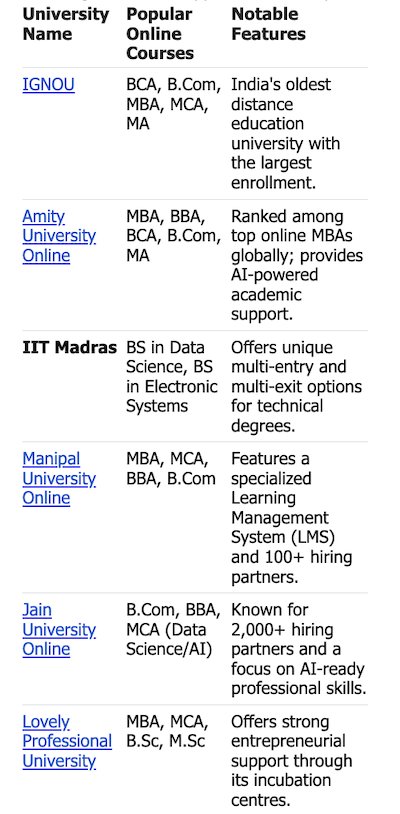

Popular Online Degree Courses
The most in-demand programmes currently include:
• Management: Online MBA and BBA account for approximately 45% of total enrolments.
• Technology: BCA, MCA, and specialized B.Sc./M.Sc. tracks in Data Science, AI, and Cybersecurity represent about 35% of enrolments.
Traditional Streams: B.Com, BA (English, Sociology), and M.Com remain popular for their broad career applicability.
Admission Process Overview
Most online universities follow a fully digital admission cycle:
1. Registration: Creating an account on the official university portal.
2. DEB-ID Generation: Required for many government-recognized institutions.
3. Application: Entering academic details and uploading scanned documents (10th/12th marksheets, ID proof).
4. Fee Payment: Paying registration and semester fees via online gateways like UPI or Net Banking.
5. Confirmation: Receiving an admission letter and access credentials for the university’s LMS.
However, online education in India is not without challenges. One major issue is the digital divide, where students in rural or economically weaker sections may lack access to reliable internet or devices. Additionally, the absence of face-to-face interaction can impact student engagement, motivation, and the development of social skills. Concerns about the credibility and recognition of certain online degrees also persist, although this is gradually improving as regulatory frameworks evolve.
Quality assurance is another important concern. While many reputed institutions offer high-quality online programmes, there are also platforms that lack proper accreditation or deliver substandard content. Therefore, students must carefully evaluate the credibility of courses and institutions before enrolling.
Despite these challenges, the future of online higher education in India looks promising. Advancements in technology, such as artificial intelligence, virtual classrooms, and interactive learning tools, are enhancing the online learning experience. Blended learning models, which combine online and offline methods, are also gaining popularity and may become the standard in the coming years.
In conclusion, online higher education in India is revolutionising the educational landscape by making learning more accessible, flexible, and affordable. While challenges like the digital divide and quality assurance need to be addressed, the continued support from the government and technological advancements will likely strengthen this mode of education. As India moves towards a knowledge-based economy, online higher education will play a vital role in shaping the future of its workforce.