From Conservation to Climate Action
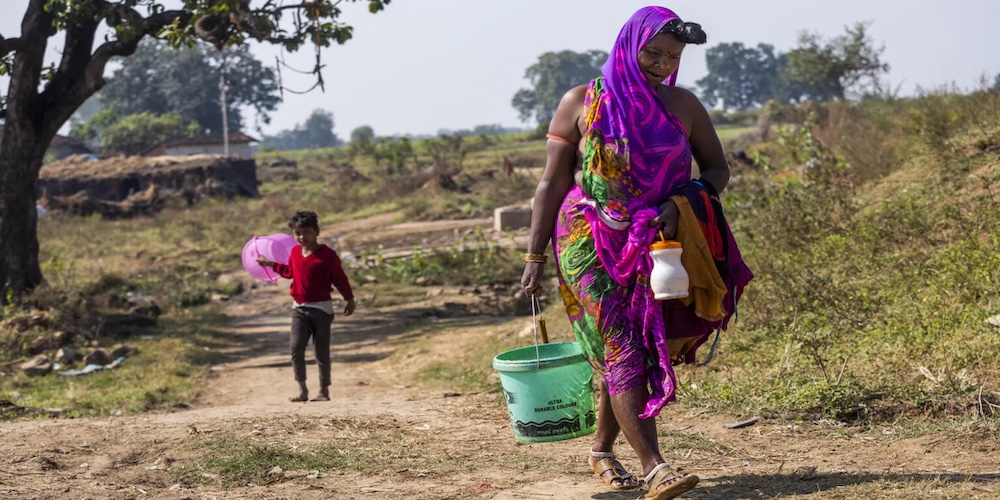
India is shifting from traditional conservation to proactive climate action by integrating biodiversity protection with economic growth, aiming for net-zero emissions by 2070. Key strategies include renewable energy expansion (500 GW non-fossil capacity by 2030), the MISHTI mangrove initiative, and Lifestyle for Environment (LiFE) to combat climate change and biodiversity loss.
Balancing rapid economic growth with biodiversity protection and climate action is always complex. But countries do this as a “Green Pathway” is becoming essential for human survival.
As the impacts of climate change become increasingly evident across regions and sectors, India has recognised it not as a distant risk but as a present developmental reality requiring both preparedness and proactive mitigation. Accordingly, India has adopted a calibrated approach that simultaneously strengthens biodiversity conservation, builds climate resilience and advances sustainable growth.
India is one of the world’s 17 mega-biodiverse countries. Despite occupying just 2.4% of the global land area, it accounts for nearly approximately 8% of all recorded species worldwide. The country is home to over 96,000 animal species and 47,000 plant species, including almost half of the world’s aquatic plant species. This extraordinary natural heritage makes conservation not merely an environmental concern, but a national imperative.
The country’s biodiversity governance framework is anchored in the Biological Diversity Act, 2002, supported by the National Biodiversity Action Plan and aligned with the Convention on Biological Diversity. India became a signatory of CBD in 1992.
In 2024, at COP16 of the Convention on Biological Diversity (CBD) in Cali, Colombia, India launched its updated National Biodiversity Strategy and Action Plan (NBSAP) 2024–2030. The roadmap aims to halt and reverse biodiversity loss by 2030, with a long-term vision of living in harmony with nature by 2050.
As it is India has some Core Environmental Laws:
• Wildlife (Protection) Act, 1972 – Protection of wild animals, birds and plants; creation of protected areas.
• Water (Prevention and Control of Pollution) Act, 1974 – Prevention and control of water pollution.
• Forest (Conservation) Act, 1980 – Regulation of diversion of forest land for non-forest use.
• Air (Prevention and Control of Pollution) Act, 1981 – Control and abatement of air pollution.
• Environment (Protection) Act, 1986 – Umbrella legislation empowering the Central Government to protect and improve the environment.
• Biological Diversity Act, 2002 – Conservation of biodiversity, sustainable use and access-benefit sharing.
Together, these legislations establish a comprehensive regulatory framework ensuring ecological balance, sustainable resource management, pollution control, and long-term environmental security.
Protected Areas and Wildlife Conservation Programmes
India has implemented the following key programmes to conserve wildlife and protect endangered species.
Protected Areas: The Protected Areas network expanded from 745 in 2014 to 1,134 in 2025. Wildlife corridors have been identified to connect habitats and ensure safe animal movement.
Key Species Projects:
• Project Tiger: Tiger Reserves increased to 58 (the newest being Madhav Tiger Reserve).
• Project Elephant: Expanded to 33 reserves, securing 150 elephant corridors across 15 states.
• Project Cheetah: The population has reached 30 (including 19 cubs born in India). The project is expanding to new areas like Gandhisagar Wildlife Sanctuary.
• Project Snow Leopard: The first assessment estimated 718 snow leopards (highest in Ladakh). Phase 2.0 was launched in late 2025.
• Project Dolphin: Estimated 6,327 riverine dolphins (2021–2023). A second range-wide survey covering major rivers launched in January 2026.
• International Big Cat Alliance (IBCA): India led multi-country, multi-agency coalition that brings together 95 big cat range countries, non-range nations interested in conservation, creating a unified platform for collaborative action and knowledge sharing.
• Launched by India in 2023 during the 50 years of Project Tiger, IBCA was later approved by the Union Cabinet with its Secretariat headquartered in India.
• Wildlife Week 2025 Launches: Introduced new national projects for the Sloth Bear and Gharial, emphasizing a landscape-level strategy that combines species protection with forest ecosystem restoration.

Forest and Biosphere Conservation:
o Biosphere Reserves: India maintains a network of 18 Biosphere Reserves. Of these, 13 are recognized under UNESCO’s World Network of Biosphere Reserves, with the Cold Desert Biosphere Reserve (Himachal Pradesh) being the latest addition in September 2025.
o Forest Fire Management: To mitigate climate-induced risks, the Forest Survey of India operates a 24×7 satellite-based, real-time fire monitoring system that issues instant SMS and email alerts.
o Mass Afforestation Drive: The citizen-led Ek Ped Maa Ke Naam (Plant4Mother) campaign became a massive environmental movement, resulting in the planting of 262.4 crore saplings by the end of 2025.
Wetlands and Coastal Ecosystems:
o Mangrove Restoration: Recognizing mangroves as natural buffers, Under the Mangrove Initiative for Shoreline Habitats and Tangible Incomes (MISHTI) India restored 4,536 hectares in 2025 and identified another 22,560 hectares across 13 States/UTs for future plantation.
o Ramsar Sites: India declared 11 new Ramsar Sites in 2025, bringing the total to 98 (the highest in Asia and 3rd globally).
• Notably, Udaipur and Indore became India’s first Ramsar-accredited Wetland Cities.
o National Coastal Mission: Extended for 2025–2031 to enhance coastal climate resilience, manage erosion, and protect coral reefs.
o Blue Flag Beaches: By the 2025–26 season, 18 beaches across 7 states and 4 Union Territories achieved the international Blue Flag certification for cleanliness, safety, and sustainable management.
Human-Wildlife Conflict Management: The government has issued strict advisories to identify conflict hotspots, mandate coordinated action, and establish rapid response teams.
o To support affected communities, the government ensures that ex gratia relief for death or injury is paid within 24 hours.
o India launched a dedicated “Centre of Excellence for Human-Wildlife Conflict Management” and a specific project addressing “Tigers Outside Tiger Reserves.”
Pollution Control & Circular Economy Initiatives:
o Clean Air Success (NCAP): Out of 130 targeted cities, 103 successfully reduced PM10 concentrations by 2024–25 (compared to 2017–18).
• Notably, 64 cities saw a 20% drop, and 25 cities achieved a 40% reduction.
o Fly Ash Utilization: The government mandates 100% utilization of thermal power plant fly ash.
• In 2024–25, out of 340 million tonnes generated, a massive 332.63 million tonnes were successfully repurposed into roads (32%), cement (27%), and bricks (14%).
o Recycling Infrastructure Boom: To support sustainable development, the number of waste recycling plants in India nearly quadrupled from 2019–25.
o Extended Producer Responsibility (EPR): By December 2025, over 71,000 producers and 4,400 recyclers registered, facilitating the recycling of over 375 lakh tonnes of waste.
• India’s Plastic Waste Management Rules, 2016 introduced EPR targets up to 100% by 2024–25. The 2026 amendments allow flexibility by permitting carry-forward of unmet targets for three years, with at least one-third cleared annually.
§ Sustainable Development and Inclusive Growth: Guided by NITI Aayog, India’s overall composite SDG score has steadily increased from 57 in 2018 to 71 in 2023–24.
Climate & Strategic Policy Frameworks
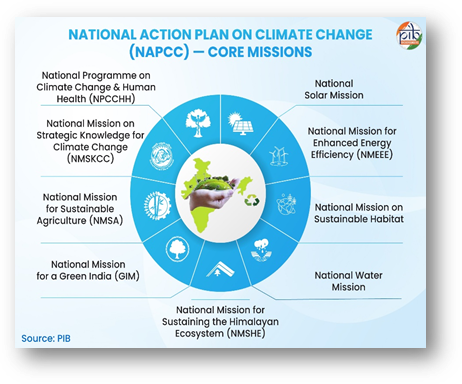
• National Action Plan on Climate Change (NAPCC) and its nine National Missions: The NAPCC provides the overarching framework for India’s climate strategy. Its missions, covering solar energy, energy efficiency, sustainable habitat, water, Himalayan ecosystems, Green India, sustainable agriculture, strategic knowledge, and later additional missions, integrate adaptation and mitigation into sectoral planning.
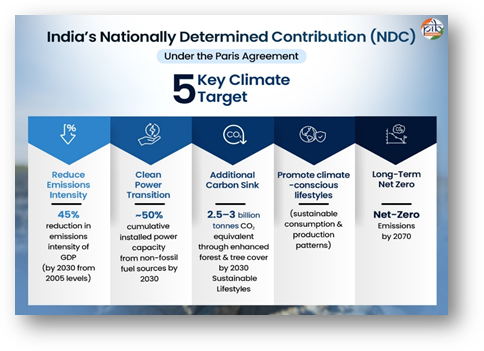
• Nationally Determined Contribution (NDC) under the Paris Agreement: In its updated NDC (2022), India committed to reducing the emissions intensity of Gross Domestic Product (GDP) by 45% from 2005 levels by 2030 and achieving about 50% cumulative electric power installed capacity from non-fossil fuel sources by 2030. By June 2025, India has already reduced emissions intensity by around 36% between 2005 and 2020 and crossed 50% non-fossil installed capacity ahead of schedule.
• Long-Term Low Emissions Development Strategy (LT-LEDS): Submitted to the UNFCCC in 2022, India’s LT-LEDS outlines pathways toward net-zero emissions by 2070.
• National Green Hydrogen Mission and renewable energy expansion targets: Launched in 2023, the National Green Hydrogen Mission aims to make India a global hub for production, usage and export of green hydrogen, targeting 5 million metric tonnes of annual production by 2030. This is supported by accelerated renewable energy deployment, with India targeting 500 GW of non-fossil fuel capacity by 2030.
Together, these instruments anchor India’s pathway from conservation to climate action, aligning ecological protection with sustainable development.