De-hyping Women’s Reservation
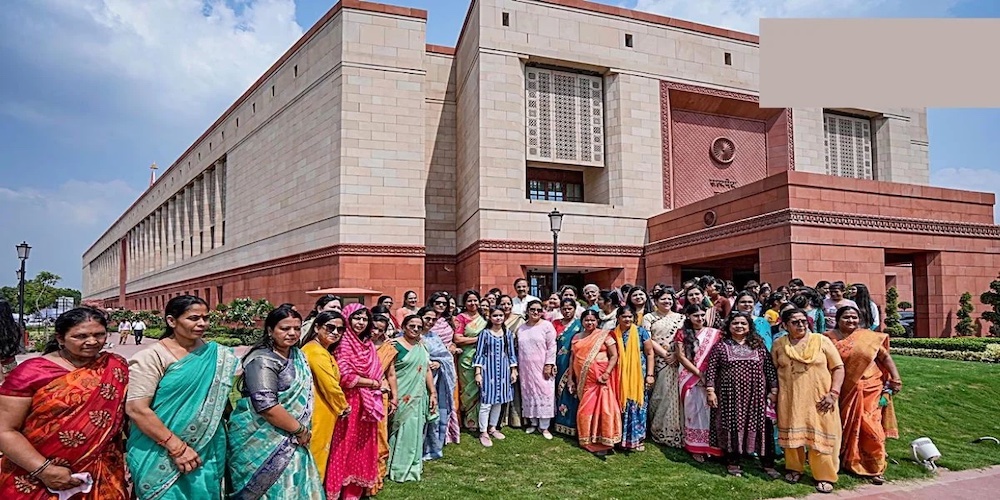
The new legislation makes one think of making some remarks, which may not be politically correct, but need to be on record
At first glance, the reported draft amendment that the Modi- cabinet approved on Wednesday (April 8, 2026) for implementing the Women’s Reservation Act (Nari Shakti Vandan Adhiniyam), which Parliament had passed in 2023, looks fine.
Now, a special 3-day Parliament session is scheduled for April 16-18, 2026, to approve the amendment to accelerate the implementation of 33% Women’s Reservation as envisaged by the Nari Shakti Vandan Adhiniyam, by 2029.
The government is pushing to use the 2011 Census to expedite the delimitation process, aiming to apply the law sooner than the previously anticipated 2034, with a goal for the 2029 General Elections.
Under the proposal, the Lok Sabha’s strength is proposed to increase from 543 to 816 seats after a new delimitation exercise. Out of the expanded total of 273 seats, about one-third will be reserved for women, with the quota also extending within the Scheduled Caste and Scheduled Tribe categories.
Prime Minister Narendra Modi’s article, published in many newspapers on April 9, 2026 has underscored that women’s reservation in legislative bodies was the “need of the hour”.
As the Prime Minister says, “Reservation for women in legislative bodies is the need of the hour! This will make our democracy even more vibrant and participative. Any delay in bringing this reservation will be deeply unfortunate”.
On a closer scrutiny, however, the new legislation makes one think of making some remarks, which may not be politically correct, but need to be on record.
To begin with, attempts at women’s reservations in legislatures have been in demand since the 1990s. But till 2023, nothing could be done as there was no political consensus. Some parties wanted a reservation within a reservation for the most backward women. Some parties did not want any such division.
It is a great irony that while Indian women’s parliamentary strength is negligible, India has had two woman Presidents( incumbent Ms. Draupadi Murmu, and Pratibha Patil), a woman Prime Minister (Indira Gandhi), two woman Speakers (Meira Kumar, Sumitra Mahajan), a woman leader of Opposition( Sushma Swaraj), country’s longest serving Finance Minister (Nirmala Sitaraman), and a woman like Sonia Gandhi, who was the supreme leader of the ruling coalition for 10 years (2004-14), even towering over the Prime Minister of the day.
In fact, in Modi’s first cabinet (2014-19) there were as many as five women cabinet ministers, including Maneka Gandhi. Moreover, it was remarkable in the sense of having a woman foreign minister (Sushma Swaraj) and a woman defence minister (Nirmala Sitaraman). In fact, no Prime Minister has promoted women in politics as much as Modi has.

However, have the conditions of women in India improved despite these tall women leaders? Not really. If the majority of Indian men remain poor in a male-dominated polity, it cannot be the case that women’s conditions will improve with more women representatives.
It is really a fallacy that a man can represent men and a woman can represent women. Therefore, the real goal of any reservation measure should be to improve women’s representation overall, not merely to increase the number of women representatives.
Who are our women leaders? Almost all of them come from the middle or upper-middle-class and elite backgrounds. In fact, one striking aspect of the demand for reservations of women in legislation came essentially from those women activists who, in some way or another, were related to established political families or centres.
This being the case, what substantial benefits will an average Indian woman get by having more women representatives from a narrow social base without increasing the level of female literacy, eradicating the problems of drinking water and fuel-wood (to collect which rural women spend hours every day) and enhancing the women’s wages in the countryside?
Viewed thus, more reservations for women means more seats for the already dominating political sections.
Besides, what is more worrisome is that the 2023 Act says that the seats reserved for women in the Lok Sabha and State Assemblies will be rotated after each delimitation exercise. This means a woman MP does not have to change her seat in the Parliament, but her constituency might become unreserved while another becomes reserved, forcing her to move to a new constituency to contest a reserved seat. That means that while their present seats will get de-reserved, they will unseat all the male legislators whose seats get reserved.
Thus, two-thirds of our legislators will be uprooted after every election, leading to a situation where no representative will be able to nurture a constituency. In fact, no representative then will care to be accountable to those who have elected him or her.
That is why I personally would have favoured an alternative which former Prime Minister Atal Bihari Vajpayee had once suggested — making it mandatory by law for every recognised political party to field women to the extent of 33 per cent of its total candidates in every election. This approach is more scientific, less divisive and would ensure that every political formation would better represent its support bases.
Also, under this approach, no political party would like to be seen as a party that promotes women of a particular background. Even if it does (which is quite possible for small regional parties dominated by particular sections of society), in the final analysis, things would even out since there are other formations that would promote women of the rival sections. That would be a level-playing field.
Of course, Modi is not Vajpayee. As the incumbent Prime Minister, the former must have had his own calculations, and one has to respect and live with that.
But in this free and democratic country, one has the right to de-hype what is appearing in the political parlance about the proposed women’s reservation. Reservation does not necessarily lead to empowerment. Nor does it necessarily strengthen democracy.