Globalisation of Indian Pharmaceutical Industry
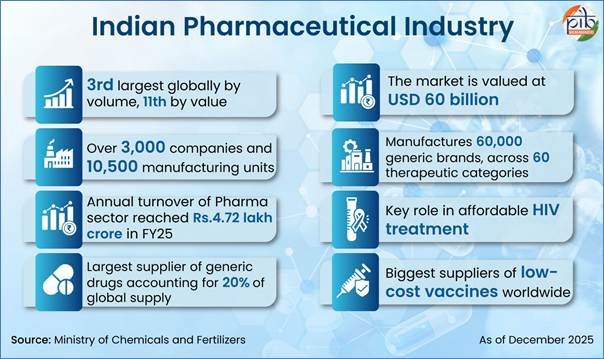
India’s pharmaceutical industry is the 3rd largest globally by volume and 11th by value, acting as the “Pharmacy of the World” with a USD 60 billion market projected to hit USD 130 billion by 2030. Providing 20% of global generic supply and 60% of vaccines, India dominates in affordable, high-quality medicines across 191 countries.
India’s standing as the Pharmacy of the World is rooted in the unique combination of affordable pricing and assured quality, which has made Indian medicines widely preferred across global markets. Cost-efficient manufacturing, supported by a strong scientific workforce and scale, has enabled the consistent supply of essential drugs without compromising standards.
As mentioned, the Indian pharmaceutical industry ranks 3rd globally by volume and 11th by value, with more than 3,000 companies and 10,500 manufacturing units. The domestic pharmaceutical market, valued at USD 60 billion, is projected to reach USD 130 billion by 2030.
As per Economic Survey 2025-26, in FY25, the sector’s annual turnover reached Rs. 4.72 lakh crore, with exports growing at a CAGR of 7 per cent over the last decade (FY15 to FY25). India is the largest global supplier of generic medicines, accounting for around 20 per cent of global supply, manufacturing about 60,000 generic brands across 60 therapeutic categories. By expanding access to affordable HIV treatment and emerging as a leading global supplier of cost-effective vaccines, the pharmaceutical industry continues to advance public health outcomes domestically and internationally while generating economic opportunities.
India hosts the highest number of manufacturing plants approved by the United States Food and Drug Administration (USFDA) outside the United States of America, reinforcing international confidence in the safety and quality of Indian pharmaceuticals. There are about 500 active pharmaceutical ingredient (API) manufacturers, accounting for nearly 8 per cent of the global API industry.
Pharmaceutical Exports – Global Reach and Investment Growth
India is the global leader in the supply of Diphtheria, Tetanus, and Pertussis (DPT), Bacillus Calmette-Guerin (BCG), and measles vaccines. Indian manufacturers provide about 60 percent of vaccine supplies to the United Nations International Children’s Emergency Fund (UNICEF), meet 40-70 per cent of global demand for DPT and BCG vaccines, and account for 90 per cent of the World Health Organization’s (WHO) measles vaccine demand. This highlights the robustness of Indian pharmaceutical exports and their substantial integration within global healthcare supply networks.
Export Performance
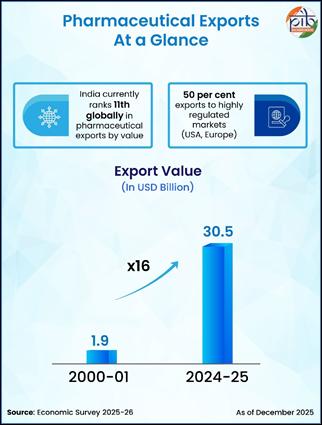
As per the Economic Survey 2025-26, India currently ranks 11th globally in pharmaceutical exports by value, with exports to 191 countries in 2024-25, of which 50 percent are directed to highly regulated markets such as the United States and Europe, reflecting wide international acceptance of Indian medicines. In 2024-25, pharmaceutical exports stood at USD 30.5 billion, a nearly 16-fold increase from USD 1.9 billion in 2000-01. Export momentum has also remained strong every month, with Drugs and Pharmaceuticals exports rising by approximately 2.70 per cent from USD 2.59 billion in January 2025 to USD 2.66 billion in January 2026. Further, medical device exports have grown significantly from USD 2.5 billion in 2020-21 to USD 4.1 billion in 2024-25, with exports to 187 countries in FY25.
Indian pharmaceutical exporters have strategically diversified their export portfolio by expanding shipments to emerging and non-traditional destinations, including Nigeria, Mexico, the United Republic of Tanzania, the Netherlands, France, Brazil, Sri Lanka, Saudi Arabia, and Spain, across bulk drugs, surgical products, and formulations. This targeted market diversification has enhanced export resilience by mitigating exposure to tariff-related risks concentrated in individual markets.
Foreign Direct Investment
The Indian pharmaceutical sector has emerged as a priority destination for foreign investors and is among the top 10 industries attracting foreign investment in India. Foreign investment flows in Drugs and Pharmaceuticals reached 13,193 Crore for the current financial year 2025-26 (up to September).
Challenges & Opportunities
While dominant in volume, India’s exports represent only about 3% of global pharma exports by value, indicating a need to move up the value chain from low-cost generics to innovation and speciality medicines.
However, with a robust talent pool of scientists and strong R&D focus, India is heavily investing in API (Active Pharmaceutical Ingredient) production to reduce import reliance, supported by many Production Linked Incentive (PLI) schemes.
The Production Linked Incentive schemes implemented by the Department of Pharmaceuticals form the cornerstone of efforts to strengthen domestic manufacturing and reduce import dependence across the pharmaceutical sector. These schemes have already resulted in the avoidance of imports worth Rs. 3,591 crore of active pharmaceutical ingredients (APIs), key starting materials (KSMs), and drug intermediates (DIs) under PLI schemes for pharmaceuticals and bulk drugs, thereby contributing to a measurable reduction in import dependency and strengthening India’s manufacturing resilience.