NEPAL GOES TO THE POLLS TODAY
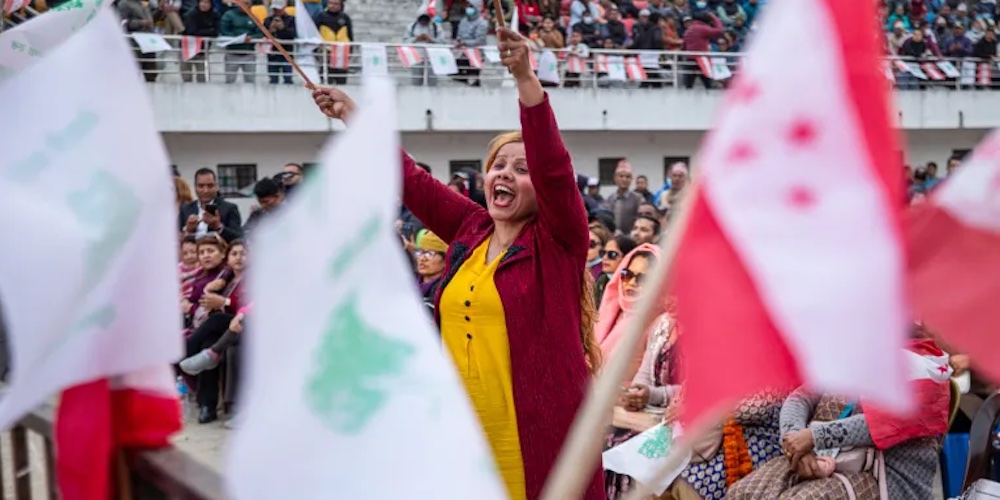
Street protests by the youth that removed the governments in India’s immediate neighbourhood, which began in 2024, are yielding political fruit in electoral terms. Myanmar is the exception, with the military engineering the victory in its own favour. But the elections in Sri Lanka and Bangladesh have produced governments that raise hopes of political stability. Now Nepal goes to the polls on March 5.
Like economic issues and unemployment, which led to street protests by the young, the use of digital platforms is common to all. Connectivity sustained the movement in Bangladesh against the Sheikh Hasina Government, and protestors thronged the streets when the K P Oli Sharma government banned their use in September last year. That forced his resignation.
Indeed, youth power, backed by technology that allows information to travel, is a new feature on South Asia’s political map.
It has opened prospects of pushing the old guard of the political class out. Protestors succeeded in defeating Sri Lanka’s established political families. In Bangladesh, Tarique Rahman, 60, a relatively younger leader of a mainstream party, won a landslide majority. But he must reckon with an agenda of political and constitutional reforms mooted through a referendum, which was also received with a 60 per cent-plus ‘yes’. The young won only six of 299 seats, but are poised, along with the main opposition, to agitate for reforms.
Nepal shows a similar surge of the young, except that Gyanendra Shah, 78, its former king, has issued an appeal asking whether elections should proceed before Nepal resolves its crisis. His eight-minute video, released on February 18, has given a fillip to the monarchical tradition deeply embedded in the Nepali society.
“While periodic elections for the selection of representatives are a natural process in a democratic system,” Gyanendra said. According to him, “the prevailing public sentiment at this time is that it would be more appropriate to first resolve the nation’s pressing problems before proceeding with the upcoming elections”.
Significantly, during the September 2025 protests, talk of restoring the monarchy resurfaced. Some saw the former king as a symbol of stability. Hundreds gathered to greet him on his birthday amid the unrest, reported The Himalayan Times.
When corruption, unemployment and nepotism among the privileged who send their children to study or work abroad are among the major issues, the effect of Gyanendra’s appeal to postpone the election confuses the voter. Now that the election is on, it needs to be watched. More importantly, the voters include eight lakh first-time voters.
Despite the former monarch’s stand, the interim government of Susheela Karki, a former Chief Justice, has, however, pushed ahead with the election within the timetable stipulated in the Republican Constitution. Two voters’ slips have been prepared, using which the 1.9 million electorate will vote for the lower house and for the upper house in a curious mix of the first-past-the-post system and the one that provides proportional representation. This is Nepal’s first.
Close to 3,500 candidates are contesting across 165 parliamentary constituencies. Thirty-three per cent of seats are reserved for women.

Now, a look at major candidates among a plethora of political parties. While septuagenarian Oli, heading the Communist Party of Nepal (Unified Marxist–Leninist) or (CPN-UML), is keen to return to the prime ministership that he has held three times before, he has to contend with the youth in the shape of Balendra (Balen) Shah, 35, a former rapper who resigned last week as Kathmandu’s Mayor.
Shah, who is half of Oli’s age, is charismatic and has a strong reform platform in his campaign. But some analysts think that he is supporting the former monarch and pro-monarchy supporters.
Balen Shah is representing the Rashtriya Swatantra Party (RSP), which came fourth in the 2022 general election. This time, many analysts say it may perform much better. Shah has been projected as the RSP prime ministerial candidate.
Shah is fighting Oli in the latter’s stronghold of Jhapa, and reports say, keeping him tied down to the constituency. That has prevented him from campaigning across the country.
Oli’s other rival and comrade-in-arms, Pushp Kamal Dahal ‘Prachanda’, in his sixties, is also facing headwinds. The two, playing a political merry-go-round and staying in power by aligning with different parties has not gone well.
Sensing the shift to the young, the Nepali Congress, which once dominated the Himalayan nation’s political scene, has dumped four-time prime minister and party chief, Sher Bahadur Deuba. It has projected 49-year-old Ganga Thapa for the top post, should the party get close to it, individually or as part of a coalition.
Finally, Nepal’s situation in the current shifts in South Asia’s geopolitics, where India’s dominance is seriously challenged by China and the United States moving in. Located between India and China, Nepal has always sought to play the dual card. If it was perceived as pro-India in the days of monarchy and the Nepali Congress, the Maoist-Marxist dispensations have witnessed a shift towards China.
Nepal is part of China’s Belt and Road Initiative (BRI), having officially signed a Memorandum of Understanding in 2017. On December 4, 2024, Nepal and China signed a new Framework for Belt and Road Cooperation to accelerate the implementation of projects covering infrastructure, tourism, and connectivity.
India, the older partner, has not really matched China in terms of money or projects. The Marxist-Maoist governments, especially under Oli, have raised territorial disputes and shown parts of Indian territory on their map.
Nepal has experienced extreme political volatility, with 14 different government administrations and 14 prime ministers formed since becoming a federal democratic republic in 2008, and over 30 since 1990.
The first election since last year’s protests raises many questions. The events are seen as having disrupted the long-standing political consensus that had enabled Nepal to balance relations between India and China. When politically stable, Nepal exercised a measure of strategic autonomy. But the political fragmentation and influx of new politicians may threaten the coherence of that approach.
Elections have not led to stability and to multiple changes in governments. If the next government cannot restore domestic legitimacy and institutional strength, then Nepal risks shifting from an active geopolitical balancer to a more vulnerable arena of great-power competition.
In sum, Nepal heads to the polls with a weak economy, a young electorate, a splintered old guard, and a rising anti-old guard wave challenging the status quo.