ON MARK TULLY & INDIA AS NEWS HUB
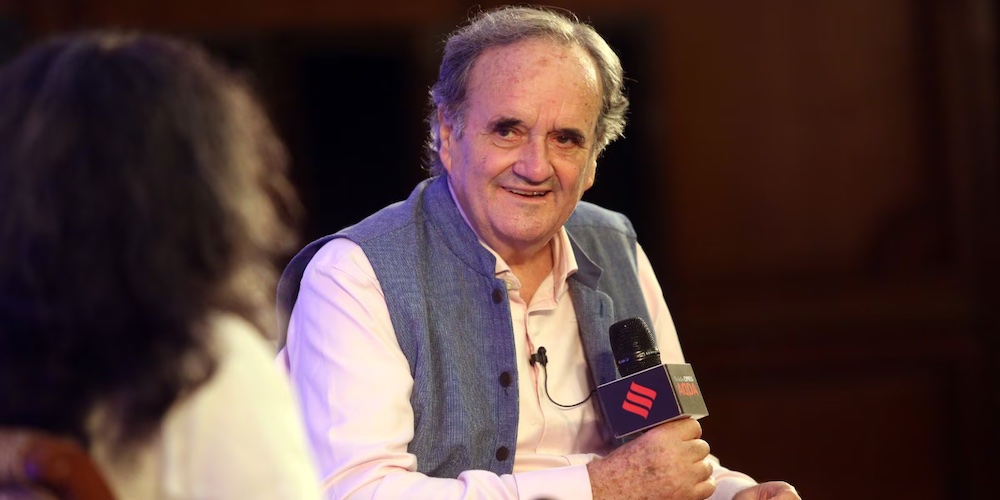
The death, at 90, of Mark Tully, just ‘Mark’ to those who knew him and “Tully Sahab” to millions across South Asia who heard him, ended an era.
He was the most famous of those who reported on India post-independence. He was avidly heard, in times when the radio was the best source of information and a family/community routine. That was before multiple television channels, the Internet, and social media arrived.
It is difficult to recall another journalist, Indian or from elsewhere, in recent years, whose death evoked so much love. He empathised with an aspirational India, yet not sparing criticism. He travelled to places and met people who were ignored as ‘local’, of little “news value.”
“Hello Mark” was how he was greeted. This writer witnessed two prime ministers in 1974, Zulfiqar Ali Bhutto of Pakistan and Sheikh Mujibur Rahman of Bangladesh, who welcomed him with a hug. There must be many more. Over three generations, it was impossible for the heads of government, whether or not they liked him and his reporting, not to know Sir William Mark Tully.
Millions listened to him on the British Broadcasting Corporation (BBC). He was popular, given the region’s colonial past. But he kept the BBC flag flying, long after India and much of the English-speaking world gained freedom.
During the press censorship days of the 1975-77 Emergency, this writer was once warned: “If you don’t carry our news, we will give it to the BBC.” Today, a plethora of foreign media bodies, old and new, report on the region, but the old resonance is missing.
A White man with no airs, Tully belonged to those he worked with, which came naturally to him. Conversant in many Indian languages, he could even use swear words! His storytelling as a journalist was different from the short stories of Ruskin Bond, another British writer, who has made India his home.
India was ‘news’ even during the colonial era. The American media took a deep interest. It is portrayed in Richard Attenborough’s film “Gandhi’(1983). The Mahatma’s Dandi March attracted foreign media. To one of them, he announced the start of the non-cooperation movement.
In 1938, the New York-based Institute for Current World Affairs awarded a 23-year-old Phillips Talbot a fellowship with the mandate to ‘report’ India. Talbott was supposedly the India Correspondent of the Chicago Daily News. But his letters addressed to the Institute’s director were never published as news reports. He interviewed Gandhi, Tagore, Nehru, Jinnah and many key leaders of the day. Until 1950, he wrote about India’s freedom movement and the Partition.

Lost and found after 50 years, these letters were published in book form as “An American Witness to India’s Partition”. It provides a unique insight into the 1940s. When this writer met him at the book’s India release in 2007, now in his nineties, he gifted a copy, signed: “with best wishes to one who follows a profession I have always loved.”
With a free press compared to its neighbours, India has been Asia’s important news hub since the Nehru era, and has hosted media from across the world, irrespective of Cold War politics. Russia’s Tass and Xinhua, the Chinese news agency, had offices, like the Japanese and European media.
Some of these correspondents wrote books on their experiences. They did not spare India’s negativities. Tully was asked to leave, but returned to report on the Emergency, the Punjab turmoil, the assassination of Indira Gandhi, whose government had expelled him, and the Babri Masjid demolition in Ayodhya.
Neville Maxwell of The Times, London, wrote “India’s China War”, which blamed India. Philip Knightly and Jason Burke represented The Guardian. The India-Pakistan conflict and Bangladesh’s liberation were reported by Peter Hazelhurst (The Times, London) and Sidney Schanberg (The New York Times).
Susanne Koelbl (Der Spiegel), Peter Heine / Thomas Assheuer (Die Zeit / FAZ circles) were from the German media. Katsuji Nakazawa of Nikkei Asia was one of Japan’s best-known Asia correspondents who wrote on India, China, and Asian geopolitics.
Some who reported India attained prominent positions in their countries. Krzysztof Mroziewicz of the Polish Press Agency (PAP), as India correspondent, also reported on the Afghan war in the 1980s. He returned as Poland’s Ambassador to India, Nepal, and Sri Lanka between 1996 and 2000. His first stop on arrival was New Delhi’s Press Club of India!
On a visit to New Delhi last month, Radosław Sikorski, Poland’s current Minister of Foreign Affairs and Deputy Prime Minister, happily recalled his days as a Journalist in India.
Russia has the distinction of having more journalists who worked in India before reaching high political and diplomatic positions. Yevgeny Primakov, before becoming foreign minister and later the prime minister, was a major Soviet-era journalist. He wrote extensively on India and the Third World. So were Mikhail Kapitsa and Viktor Goncharov.
Most of them spoke Hindi. Alexander Kadakin, a journalist-analyst, returned to India as ambassador. He died in that post. Delhi has a road named in his memory.
India continues to “make news” in this volatile, highly polarized times. For developments and their analyses, a nation of 1.4 billion, and a 35.4 million living outside, it cannot be ignored.
This writer may be forgiven for returning to Mark Tully to stress what he meant to the Indian diasporas hungering for news from India. My daughter, then in Bahrein, expecting her first child in 2003, says: “BBC News was the only radio/TV channel available those days. He was the only ‘company’ I had from India.”
RIP, Mark!