AS BANGLADESH WELCOMES TARIQUE RAHMAN
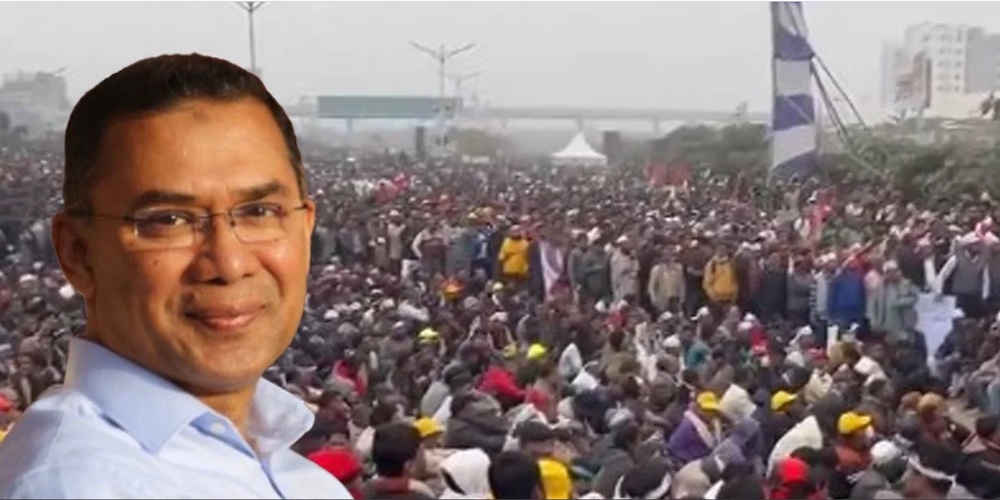
From welcoming their new nation’s founding leader, Sheikh Mujibur Rahman, on January 10, 1972, to Tarique Rahman this week on December 25, almost 55 years apart, the people of Bangladesh have seen their history change more often than one can imagine.
In between came assassinations of two Presidents, 15 years of military-led rule and alternating in civilian power between Begum Khaleda Zia and Sheikh Hasina.
Since Hasina was ousted following street protests, much water has flowed down the Jamuna/Padma. The country, yet again on a precipice, is struggling to end recurring violence and is seeking political stability, the only way it has known: an election two months away.
Tarique Rahman’s return, being facilitated by the interim government, ensures that they will be held. That is also what those in the West who wish Bangladesh well would want. In his likely success, they may be seeing a generational change, leaving behind the deep reservations that Bangladesh’s emergence in 1971 had created. Perhaps, some satisfaction now that the diplomatic damage they had suffered due to their separation from Pakistan is gradually being repaired.
Circumstances have thrust a great responsibility on Tarique as the son of another leader of that freedom movement, and like Mujib, another slain President, General Ziaur Rahman. His mother, the two-term premier (1991-96 and 2001-2006), is seriously ill. His return after 17 years’ exile ends the uncertainty.
Tarique is widely perceived as the front-runner in the elections, and that, besides changing perceptions for the better, also allows people to imagine a path forward.
This may also change perception about him. In the past, he was accused of corruption and running a “parallel government” when his mother was the prime minister. He is not known to have experience in governance per se. The long years of staying away, even though he ran the party from London, make his task even more challenging.
He is not a run-of-the-mill Bangladeshi politician, high on high-decibel rhetoric. He did not swear vengeance against his family’s tormentors. He promised “a plan” for a “safe Bangladesh” for all communities, all of them sorely needed.
As he prepares for a tough poll campaign, he may be walking into a political snake pit. Leading a centrist party with nationalism as its ethos and a role in the freedom movement, it remains to be seen how he will counter the rising tide of the Islamists, particularly those working for a ‘Khilafat’ in Bangladesh, who have had a free run under the interim government.
The Islamists have no reason to like him, also the leaders of the 2024 protest movement who have floated a political party and want their role recognised and perpetuated politically.
Tarique’s task will be tougher, many times over, if he wins and takes power, although his mother had aligned with the mainstream Jamaat-e-Islami.
This is where India, the larger neighbour and a friend-turned critic, comes. Neither can wish each other away.
Since Hasina’s ouster, India’s security concerns have risen considerably. What should also worry the world is the rise of Wahhabi Islam in a region otherwise known for its moderate ways. Their rise makes India’s east and north-east vulnerable.

These developments pose the “greatest strategic challenge” since the Liberation War, an Indian Parliamentary panel has said in its report. It suggests that Bangladesh is witnessing a “shift” and that New Delhi could end up losing the “strategic space” in Dhaka without necessary recalibration.
“The challenge in 1971 was existential, a humanitarian crisis, and the birth of a new nation. Today, the threat is subtler but probably graver, more serious; a generational discontinuity, a shift of political order, and a potential strategic realignment away from India.”
Like most past elections, the February 2026 elections will have India as a talking point. More so, for hosting Hasina. She and her party have been debarred from contesting, and to that extent, the election may lack legitimacy.
But they may gain acceptance. Like with her father, foreign critics have already passed a harsh verdict on Hasina.
Former Indian foreign secretary Nirupama Rao’s assessment differs: “Her foreign opponents fixated on Hasina through a narrow lens: elections that didn’t meet Western democratic aesthetics, long incumbency, centralised power, human rights reports. All real issues, but treated in isolation, stripped of context. Bangladesh was judged, not a fragile, densely packed state with a violent Islamist history and a traumatised political culture.
“In doing so, three hard realities were ignored.
“First, Hasina was a stabiliser, not a revolutionary hero, but a state-builder in a hostile environment. She kept Jamaat and its offshoots contained, maintained civil-military balance, protected minorities better than any realistic alternative, and kept Bangladesh economically and geopolitically predictable. Her western opponents knew this. They just chose to downplay it.
“Second, they overestimated the “democratic opposition”. There was no credible, unified, liberal alternative waiting in the wings. Removing pressure from Hasina didn’t empower democrats. It empowered street power, radicals, and actors who thrive precisely when institutions weaken.
“Third, there was the old habit of believing that toppling or de-legitimising a strong incumbent automatically opens space for pluralism. History says the opposite. In divided societies, power vacuums don’t fill with moderates. They fill with the loudest, angriest, and most organised forces. Often religious, often violent.
“These were destructive missteps. Not because Hasina was flawless, but because state collapse is always worse than imperfect order. Chasing democratic optics ended up accelerating a counter-revolution that hollowed out politics, normalised persecution, and destabilised an entire country.
This wasn’t values-driven paternalism. It was context-blind activism masquerading as strategy. And Bangladesh will pay for it long after the policy memos have been forgotten.”
Take note of what renowned Bangladeshi economist Rahman Sobhan has to say. Although Bangladesh fought for freedom from Pakistan for democracy, over the last 54 years, what has emerged in Bangladesh is an ‘illiberal’ democracy. “The source of the problem lies in the appropriation of power in an all-powerful leader, whether as President or elected Prime Minister and the tribalization of our democratic politics, which has led to a ‘winner take all’ culture.”
This is largely true.
One hopes these warnings are heeded, whoever rules Bangladesh.