OF “OPEN SECRETS” & NORTH-SOUTH SEALANE
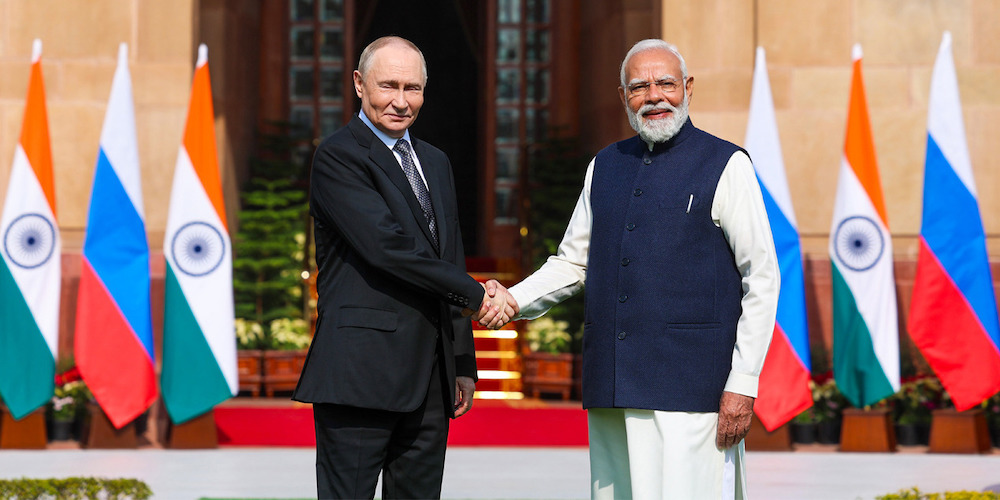
We are left to guess about the “open secret” of what transpired at the 23rd India-Russia summit, which took place in New Delhi on December 4-5, but it is not difficult to do so.
Russian Ambassador to India Denis Alipov has stated that “we have kept some parts of the talks under wraps.”
None of the defence deals that were speculated before President Putin’s visit figured in the joint statement issued at the end of the visit.
But we, too, shall not speculate.
Participating in “Diplomats’ Diaries” at the Observer Research Foundation (ORF), the good diplomat that he is, did not go into specifics. But he spoke of “attempts at damaging India-Russia relations” and that “bad actors are watching.”
Old records mention Sir Chunilal Mehta, a Bombay entrepreneur who obtained global cotton market rates from New York via the east instead of the traditional London route. He got them just two minutes ahead of the competition and minted millions.
Something similar is happening, opening an eastern vista for India. It also has the potential to change the geopolitical ballgame.
A less-discussed part of the India-Russia talks during this month’s visit of President Putin, which was otherwise under scrutiny in many national capitals for defence and energy issues, was measures to step up work on the Eastern Maritime Corridor (EMC), which connects Chennai, India, with Vladivostok, Russia’s Far East.
MOUs were signed for building ships that can sail into the “snow-bound sea” of Russia’s northern region and for training Indian personnel to sail into the Arctic.
Under this formal framework, Russia is to provide specialised training to Indian maritime specialists for navigation in challenging polar conditions. This initiative aims to create new employment opportunities for Indian youth and position India as a key player in Arctic logistics.
Analysts say that, besides avoiding Red Sea disruptions through a turbulent Middle East, in the long run, this route could radically alter maritime trade.
These plans mark a new era of maritime cooperation, providing India with access to Russian expertise and new trade routes while helping Russia develop its Arctic ambitions amid Western sanctions.
In broad geopolitical terms, while deepening Indo-Russian ties, it increases India’s maritime presence in the Indo-Pacific region. It also allows India a measure of autonomy, both to choose sea lanes for its maritime trade and to better withstand in future issues like the current one over tariffs and sanctions with the US and Western allies, who are generally wary of the Russia-China presence in the Pacific region.
With initial steps taken in 2019, the seaway is already operational, carrying oil, food and machines, Minister of Ports, Shipping and Waterways Sarbananda Sonowal said on November 18, 2024.

This sea route is projected to add $10-15 billion annually by cutting transit time and costs for key goods like coal, oil, and fertilisers, with total trade expected to hit $100 billion by 2030, though most current trade (around $65B in 2024) flows through other routes, primarily energy imports from Russia.
Analysts say the route remains vital, no matter what the near future holds for India importing Russian oil, with or without the concessions that have raised hackles in the West.
The 10,300 km (5,600 nautical miles) route aims to boost trade by significantly reducing travel time to only 10-12 days compared to the Suez Canal route from Mumbai, which takes 41 days. It passes through the South China Sea and Malacca Strait, serving as a key alternative for energy/goods transport.
Ships sail from Chennai into the Bay of Bengal, pass the Andaman and Nicobar Islands, head through the Strait of Malacca, navigate the South China Sea past Southeast Asia, and then proceed through the East China Sea into the Sea of Japan to reach Vladivostok, Russia’s major Far East port and terminus of the Trans-Siberian Railway.
Other ports with the potential of being linked include Visakhapatnam, Kolkata, Vostochny and Olga. Russia has proposed to include Vietnam, Thailand, and Indonesia as intermediate stops in the route.
The Joint Statement issued at the end of Putin’s visit stated: “The two sides agreed to deepen cooperation in building stable and efficient transport corridors, with the focus on expanding logistics links for improving connectivity and enhancing infrastructure capacity to support the International North-South Transport Corridor (INSTC), the Chennai–Vladivostok (Eastern Maritime) Corridor, and the Northern Sea Route.”
Discussions are underway for Indian shipyards (both state-owned and private) to construct four non-nuclear ice-class cargo vessels valued at over $750 million to support Russian operations in the Arctic. This will help meet the growing demand for specialised ships as Russia seeks to expand its capacity.
Russia’s state-owned nuclear energy company, Rosatom, is the infrastructure operator for the NSR and aims to make it a year-round transport artery.
A joint working body has been established within the India-Russia Inter-Governmental Commission on Trade, Economic, Scientific and Technological Cooperation (IRIGC-TEC) to oversee the cooperation on the Northern Sea Route, including Arctic shipbuilding and sailor training.
The ground for further work was laid in August, amidst the looming threat of additional tariffs. The announcement was made at the 26th meeting of the India-Russia Intergovernmental Commission on Trade, Economic, Scientific, Technical and Cultural Cooperation on August 20, which was attended by S. Jaishankar, India’s Minister of External Affairs.
Russian First Deputy Prime Minister Denis Manturov announced that Russia and India target joint exploration of the Northern Sea Route and the North-South corridor.
“It is obvious that the expansion of trade and economic ties is also linked to forming reliable logistical corridors and creating new container services. We target joint development of the Northern Sea Route and the North-South Corridor in this regard,” Manturov, highlighting the scale of trade between the two countries.