INDIGO NOT SUPPOSED TO COMPROMISE ON AIR SAFETY
Without norms governing safety, nothing can work smoothly : factory, surface, rail, water or air transport. Air transport has not only picked up momentum in India in the last four decades, it has also given a stiff competition to the Railways.It has ensured saving of time vis a vis money spent. Overall, it has bolstered tourism, education and travel sectors.
As on date, India is the third largest domestic aviation market after the U S.A. and China. Rapid urbanisation, tourism, urge to avail of better avenues of education and employment and rise in purchasing power of the middle class could be reasons for such growth.
But today’s passenger also looks for travelling safely, apart from value for his hard earned money. He/she wishes that the journey should be free from all encumbrances.
For keeping the air carriers on track, rules and procedures are developed by the national and international authorities, such as, International Civil Aviation Organisation (ICAO) and Director General Civil Aviation (DGCA) of India.These cover maintenance of aircraft, daily operations, air worthiness, checks to be carried prior to a flight etc.These also focus on sufficient training of pilots and crew, passenger protection, smooth take off and landings and timely reporting of accidents.
While international and national organisations make sets of rules based on global standards, not only these should be obeyed by air operators, they need to have their own timely checks and audit devices as well.
With tremendous rise in air traffic, rest to pilot on a daily basis and adequate weekly rest are also necessary. It goes without saying that during night flights and during adverse conditions, extra precautions also have to be taken.
It is also necessary to exercise full control over and around air space. Around some major airports, constructions not only keep taking place but certain activities invite bird hits as well which may lead to accidents.
Regular learning from mistakes of pilots and aircraft accidents too has to be ensured.In this regard the invention of Black Box or Cockpit Voice & Flight Data Recorder in 1958 was a significant development.
INDIAN CIVIL AVIATION SCENARIO
A beginning was made by the Tata Airlines which later on took the shape of Air India.Gradually Air India began concentrating on the overseas sector while the domestic sector was taken care of by the Indian Airlines.
But mismanagement was their hallmark right from day one.
OPEN SKY POLICY
When skies were opened for the first time, new companies, such as, Jet Airways, Air Sahara, Kingfisher Airlines, Paramount Airways, Go Air, Modiluft, Deccan Air, TruJet etc entered the scene. None of them, except Jet Airways(started in 1993) could carry on in such a stiff business scenario and went on withdrawing one after another. Massive capital investment needed to cater to a vast country like India was perhaps lacking at this juncture. While Jet Air took over Air Sahara in 2007, prior to ceasing operations in April 2019, Kingfisher Airlines acquired Deccan Air in 2008 before shutting down in October 2012. In the same way, Paramount Airways, TruJet and Go First(earlier GoAir) became part of history in 2010, 2022 and 2023 respectively.Some budget airlines too tried their luck but they too had to withdraw sooner than later.
ADVENT OF INDIGO
IndiGo which started operations on August 4, 2006 became a new competitor to Jet Air, Air India and Indian Airlines. Certain uncovered sectors were looked after by Spice Jet & GoAir simultaneously.
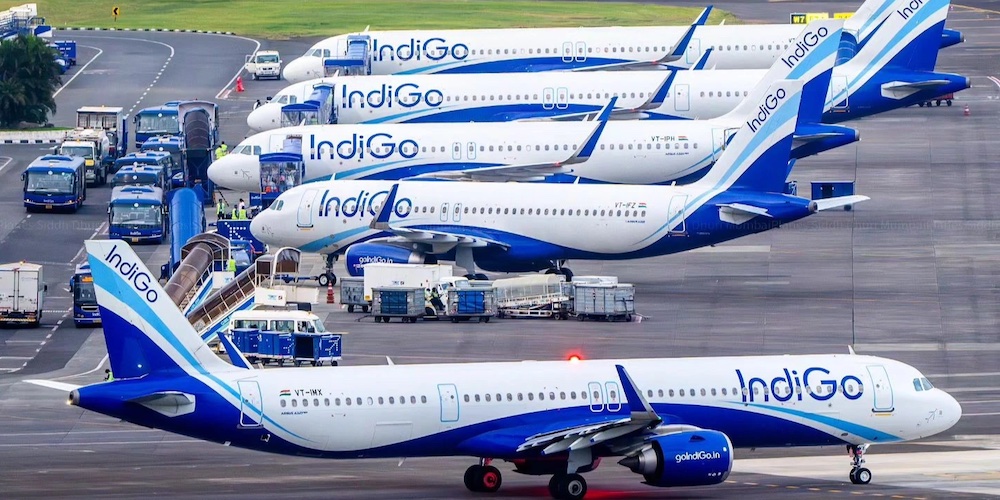
As on date, IndiGo has 400 aircrafts, mostly Airbus A320. It operates about 2300 flights a day of which 950 to 1000 are international. To begin with, it was punctual upto 90%, had high aircraft utilisation and was cost efficient. However, it has been learnt that by November 2025, its punctuality had come down to 67.7% from 84.1% in the previous month. By December 1, it came down further to 49.5% to 35 % on December 2 and reached a low of 19.7 % on December 3.
ABSENCE OF A NATIONAL CARRIER
Two years ago, Government of India decided to sell both Air India and Indian Airlines to the Tatas for which a lot of criticism emerged because of writing off huge debts. Government was also criticised for leasing out six major airports to a company of Gujarat.
As on date, there is no national carrier. IndiGo, whose market share was 40% in 2016, by covering 138 destinations now controls 60 to 63 % of business. Air India is taking care of 27 % and the rest of the operations are handled by Akasa Air and Spice Jet.
As IndiGo has run into trouble with DGCA on the issue of a new set of Pilot Rules known as FDTL, let us throw some light on it.
FIXED DUTY TIME LIMITATIONS (FDTL)
These rules notified by DGCA have set maximum duty hours, flight times, night operations, minimum rest period for pilots and cabin crew so that they don’t get tired and their safety is also ensured. Idea is to improve air safety by having a fixed work period and rest so that flight operations do not get affected.
In brief, it regulates duty, mandates rest and prevents fatigue which is a major safety concern often linked to incidents/accidents. Rest periods between duties and 48 hour weekly breaks were very much needed as opposed to 36 hours earlier. Only two night landings as opposed to six earlier and not more than two continuous night duties were also correct steps in favour of pilots. Further, as fatigue happens during early morning departures and night landings, quarterly fatigue reporting was correctly made mandatory to the DGCA.
RULES NOT NOTIFIED ALL OF A SUDDEN
These were not new sets of pilot rest rules but were conveyed by the DGCA to all the airlines in January 2024. However, these had to be deferred in March , 2024 due to resistance from all airlines. Government should have been strict at this juncture.
Finally, these were notified to be implemented in two phases from July 1, 2025 and November 1, 2025. Hence, sufficient time was given to all the airline companies.
Aim of DGCA was to be in line with safety standards followed by ICAO, European Union Aviation Safety Agency (EUASA) and Federation Aviation Administration (FAA) of U.S.A. While USA ensures 100 hours of rest to Pilots in 28 days, Emirates Air and Qatar Airlines have larger pilot pools to take care of FDTL restrictions. It has been learnt that EUASA too ensures adequate rest to the pilots.
MESS BY INDIGO IN NOVEMBER, DECEMBER
As indicated, IndiGo took the FDTL instructions rather lightly and began the implementation process only by November end. Other airlines, such as Air India, Akasa Air and Spice Jet reported a cancellation rate of barely 5% even after implementing FDTL. Further, when it comes to recruiting pilots, Akasa has added 200 lately and Air India has been also hiring more pilots for the last two years.
In contrast, though IndiGo became market leader in 2023, their promise regarding raising the salary of their pilots has fizzled out. These have reportedly recorded a rise of barely 15 % in the last 15 years.
Also IndiGo took up additional daily flights in 2025 but continued with the same strength of crew.
When IndiGo finally went ahead with partial implementation of FDTL towards November end, due to shortage of crew, a lesser number of flights began taking off. A few technology related issues too added to the crisis. According to their own admission, a record number of 1232 cancellations took place in November. Of these, 755 were due to implementation of new FDTL rules.

PEAK PERIOD OF CRISIS
Between 3rd and 4th December, cancellation percentage was 8.5 and 19.7 respectively. On 3rd December, when 38 flights of IndiGo were cancelled again (hinting at spill over the next day), DGCA asked Indigo to provide reasons for cancellations and delays and sought a plan to mitigate the emerging crisis. It was noted that flights departing from Delhi were delayed by an average of 50 minutes. Arrivals, however, were a bit smooth.
As on December 4, due to new rules having a bearing on crew, IndiGo was compelled to cancel over 250 flights across major airports with many more delayed for extended periods. IndiGo informed DGCA at this stage of its intention to begin reducing flight operations from December 8 to minimise disruptions. It expected normalcy to be restored only by February 10.
IndiGo also requested DGCA for exemptions from some night operations related changes in the new FDTL norms for pilots TILL FEBRUARY 10.
DGCA did not agree to accede to the request of the airline but asked it to submit reasons for specific relaxation, a mitigation plan listing therewith steps for stabilization and ensure progressive reduction in cancellations. Airline has also been asked to submit a detailed quarterly report.
MYSTERY BEHIND CREW NUMBERS
It was gathered that airlines had misjudged crew requirements and planning gaps were also seen under the changed circumstances.
Under the new rules, IndiGo needs 2422 Captains and 2153 First officers. It currently has 2357 Captains and 2194 First Officers.So the shortfall is obvious.
Air India, on the other hand, is able to handle the situation smoothly to operate 200 daily flights even after implementing new FDTL rules.
Apart from DGCA, K.Rammohan Naidu, Civil Aviation Minister while expressing a clear displeasure on disruptions, rightly discovered that ample preparatory time was given to the airline. In such a situation, he directed them to ensure that there shall be no increase in air fare.
Due to the prevailing situation, the On Time Performance (OTP) level of the airlines dropped from 84.1% in October to 67.7 % in November to a low of 19.7 % on December 3.
December 5 was the worst day when 1600 IndiGo flights had to be cancelled. Again on December 6 and 7, between 850 and 1000 and 650 cancellations respectively took place. It is felt that many more flights would have been cancelled even after 8th and 9th December.
Major aviation hubs, such as, New Delhi, Mumbai, Bengaluru, Hyderabad and Chennai came across severe disruptions. Passengers were stranded, chaos began being witnessed at airports, drinking water and food shortages emerged, rest rooms were choked and parents of little children were very much troubled. Worst developments were the plight of disabled, misplacement of baggage and breaking of communication between passengers and airline staff.
Some passengers, nonetheless, too were seen crossing limits while lodging protests.
JUMP IN AIR FARES
As if describing disorder and mess at IndiGo counters was not enough , air fares too sky rocketed with little bit of normalisation. Unthinkable rates began being quoted. To provide a quick solution, on December 6, the Central Government stepped in to regulate fares for all airlines by prescribing following caps from Delhi :
Rs 7,500 for 500 kms
Rs.12,000 for 1000 kms
Rs.15,000 for 1,500 kms
Rs.18,000 for over 15,000 kms
It was clarified that fare limits were applicable till further review. Idea was to prevent exploitation of passengers in distress and to ensure that senior citizens, students and patients do not face any further hardship. But in actual reality, fare caps were being implemented only progressively.
DECEMBER 6 NOTICES TO INDIGO’S C.E.O. & C.O.O.
When DGCA realized that it had failed in its task in controlling situation and inconvenience to passengers could not be minimized (in view of latest 600 cancellations), for the first time, both the CEO (Pieter Elbers) and COO (Isidre Porqueras) of erring airlines were issued Show Cause Notices for large scale operational failures, significant lapses and their acts of non- compliance.
It may be noted that it took almost ten days for DGCA to issue a show cause and that too after granting special concessions from a few changes related to night operations for pilots valid upto February 10.
DGCA ACTION CHALLENGED IN DELHI HIGH COURT
Two Pilot associations, however, have criticised DGCA’s partisan decision and have demanded that these should be withdrawn.They have also filed petitions in Delhi High Court on December 16, stating that these relaxations materially dilute and deviate from Court accepted FDTL framework and timelines. After listening to the plea that IndiGo had misjudged the requirements of pilots, the Court has issued notices both to the Ministry and DGCA to file their affidavit prior to the next date of hearing on April 17, 2026.
Surprisingly, Vikram Singh Mehta, Chairman of IndiGo has not been summoned as yet, either by the DGCA or the Ministry. Further, actions taken by its seven member Risk Management Committee pertaining to the current crisis are also not known.The high profile Committee comprises an Air Chief Marshal (Rtd), two former Secretaries to Govt. of India, three aviation experts and the CEO, Indigo.
In the meanwhile, the gesture of both Air India and Air India Express to seek permission to add to their capacity to help travellers and their baggage reach their desired destinations needs to be appreciated.
CONCLUDING LINES
Even though IndiGo operations showed little improvement by December 7 with its operation of 1650 flights, 600 cancellations side by side, can not be taken lightly. Afterall, two thousand cancellations in five days of December were alarming enough to shake the nation. Its promise to normalise operations by December 10 was not convincing.
After facing the DGCA and Minister of Civil Aviation twice each, the airline was to face the Parliamentary Committee on Transport,Tourism & Culture. Latest challenge has come from petitions in Delhi High Court, filed by Indian Pilots Guilds and Federation of Indian Pilots.
Passengers have suffered unthinkable stress owing to flight cancellations and delays in reimbursements (should have been in cash). Hundreds of marriages in this peak season could not be celebrated in the desired manner and hotel bookings, prepaid tours and travel industry too suffered immense losses.Impact was also on meetings, training and examination schedules.Special trains may have helped only a few.
All stakeholders will have to wait for the report of the probe Committee, ordered by the Ministry of Civil Aviation. Order dated December 9 to IndiGo to cut down its flights by 10 per cent may be only a tip of the iceberg.Though assurance regarding fixing of responsibility has been given, will it actually materialize ? However, indications regarding non- fulfillment of responsibility by IndiGo, coming from MoS, Civil Aviation appears significant. Responsibility has to be fixed on key officers of the Ministry also.
In Sum and Substance, Management Of Pilot Fatigue, A Key RIsk TO Aviation Safety, CAN NOT Be Compromised.

(The author is former Chief Secretary, Sikkim)